
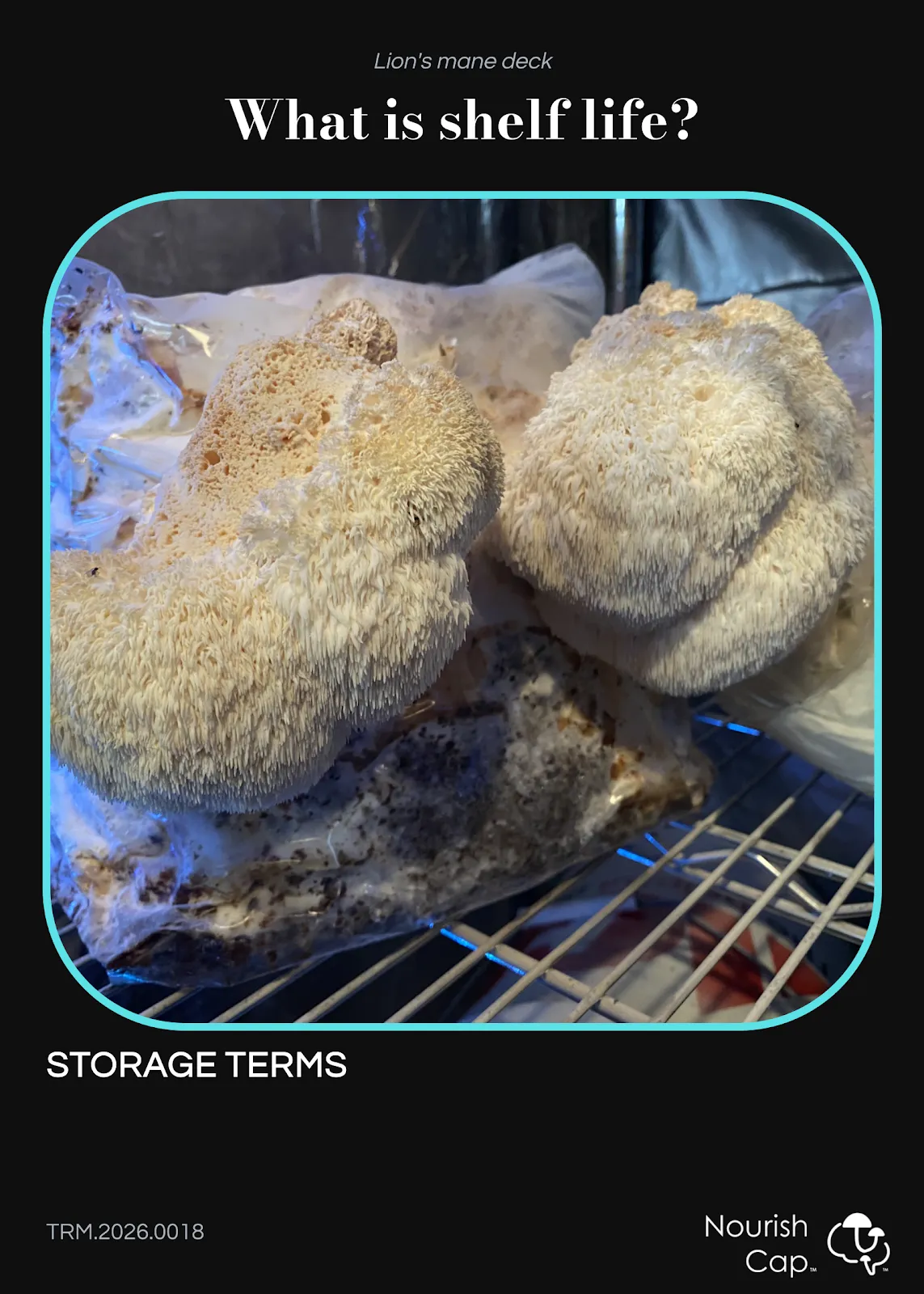
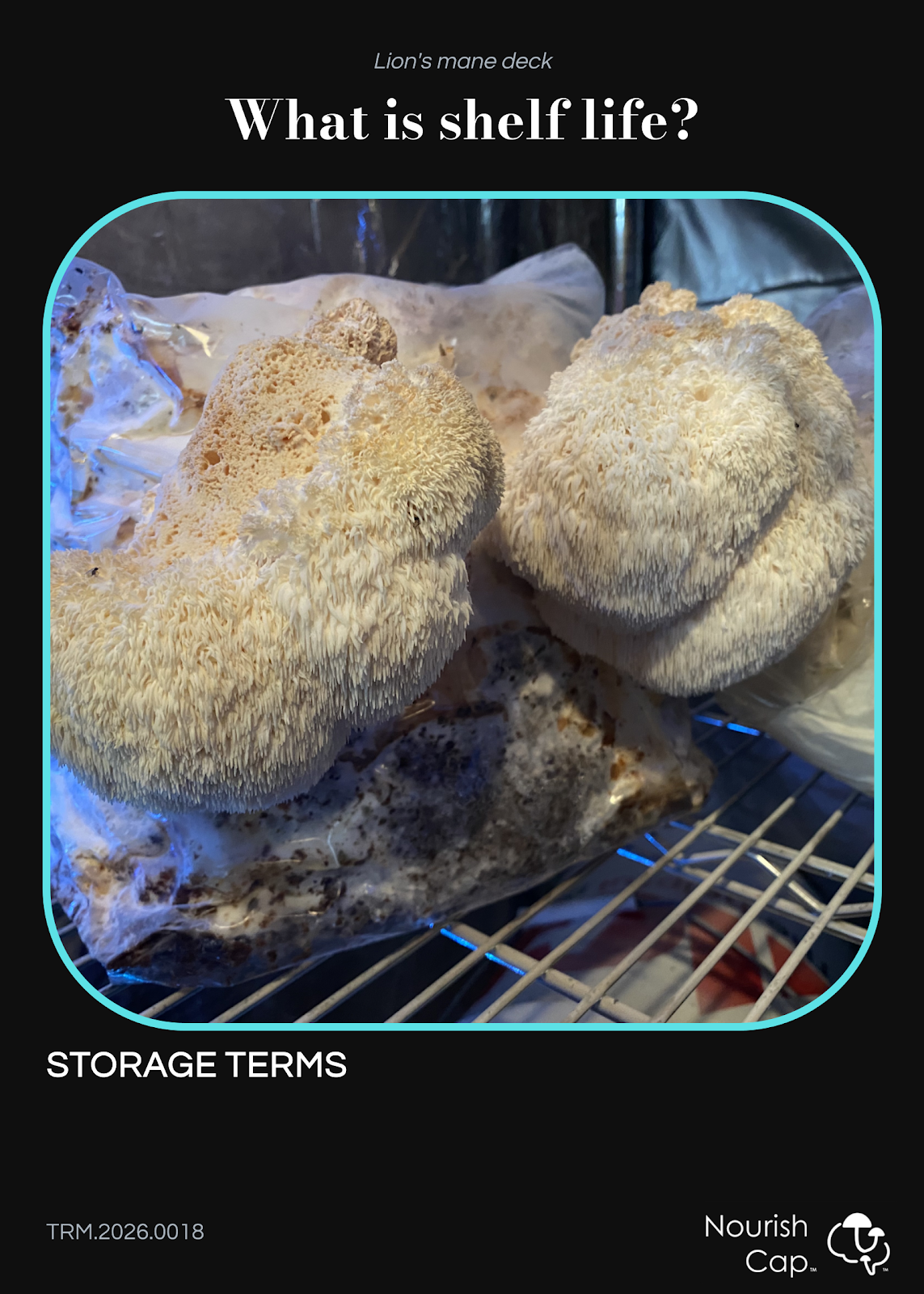
What is shelf life?
- Design
- Laboratory storage experiment comparing three constant temperatures over time, with triplicate measurements.
- Samples
- Lion's mane (Hericium erinaceus) fruiting bodies from an indoor mushroom producer, chosen for uniform size and weight.
- Conditions
- Storage at 5 °C, 13 °C and 21 °C for up to 14 days, in plastic boxes (airtight glass jars for breathing measurements).
- Measured
- Breathing (O2 and CO2), moisture, pH, acidity, weight loss, color, firmness, microbes, phenolics and antioxidant activity.
Flash card
The source
Source 1
Storage Temperature Effect on Quality and Shelf-Life of Hericium erinaceus Mushroom
Silva et al., Horticulturae 2025
DOI: 10.3390/horticulturae11020158
Open access. Excerpts are drawn from the published full text.
The study, in plain words
- Storage. Cleaned mushrooms of uniform size were divided into boxes and kept at three constant temperatures: 5 °C (refrigeration), 13 °C and 21 °C (home or supermarket).
- Timing. Microbe counts were taken at days 0, 7 and 14. The other measures were taken at days 0, 2, 4 and 7.
- Breathing. 60 g of mushrooms were sealed in airtight glass jars, and the gas in the jar was sampled with a CO2/O2 analyzer.
- Physical quality. The authors measured moisture, pH, titratable acidity, weight loss, color (with a colorimeter and photos) and firmness.
- Microbes. Counts of bacteria at 30 °C, cold-tolerant bacteria, and yeasts and molds were made on mushrooms stored at 5 °C and 21 °C. The 13 °C group was not tested for microbes.
- Bioactives. Total phenolic content and antioxidant activity (DPPH, ABTS and FRAP assays) were measured.
- Statistics. Assays were run at least in triplicate, and differences between averages were tested.
The source's own bottom line
The authors reported that storing at 5 °C was the most effective option for limiting weight loss, browning and microbial contamination while preserving firmness. At 21 °C, microbe testing stopped after 7 days because of visible spoilage.
In their words, "even under refrigeration, microbial proliferation restricts the mushrooms’ shelf life to approximately seven days." Higher temperatures, though, gave higher phenolic and antioxidant levels.
The authors read this as a case for low-temperature storage plus additional preservation methods, such as edible coatings, vacuum sealing and advanced packaging.
What you can trust
| Card | Straight from the source |
|---|---|
| What is shelf life? | "The shelf life of mushrooms is influenced by both extrinsic and intrinsic factors."1 (1. Introduction) |
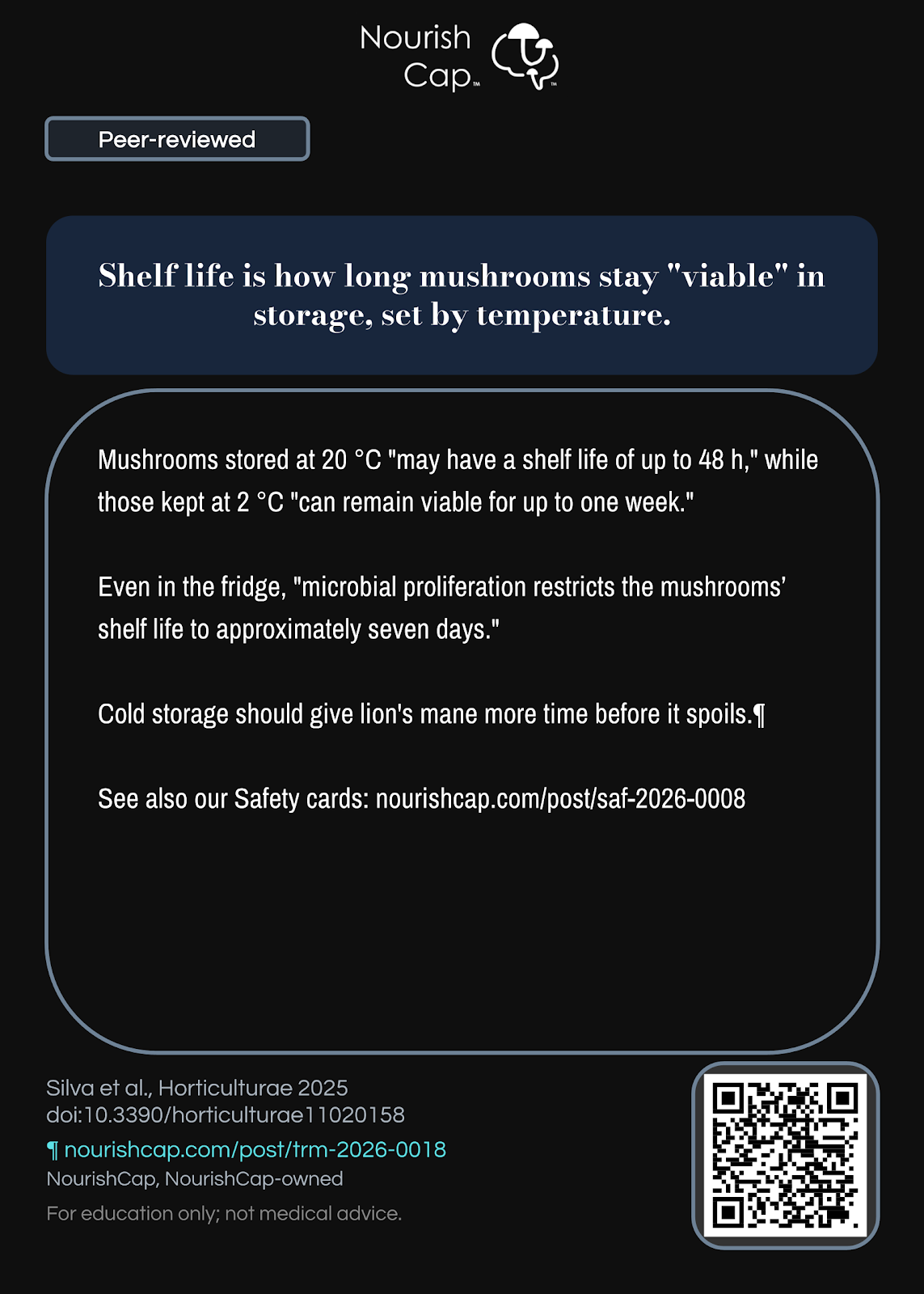
| Shelf life is how long mushrooms stay "viable" in storage, set by temperature. | "The shelf life of mushrooms is influenced by both extrinsic and intrinsic factors."1 (1. Introduction) "Extrinsic factors, such as temperature and moisture levels during storage, are critical, as most physical, biochemical, and microbiological deterioration processes are temperature dependent."1 (1. Introduction) |
| Mushrooms stored at 20 °C "may have a shelf life of up to 48 h," while those kept at 2 °C "can remain viable for up to one week." | "For instance, mushrooms stored at 20 °C may have a shelf life of up to 48 h, whereas those stored at refrigeration temperatures of 2 °C can remain viable for up to one week."1 (1. Introduction) |
| Even in the fridge, "microbial proliferation restricts the mushrooms’ shelf life to approximately seven days." | "However, even under refrigeration, microbial proliferation restricts the mushrooms’ shelf life to approximately seven days."1 (3. Results and Discussion) |
| Cold storage should give lion's mane more time before it spoils.¶ See also our Safety cards: nourishcap.com/post/saf-2026-0008 | "This research emphasizes the significant impact of storage temperature on the post-harvest quality and shelf life of He."1 (4. Conclusions) "These findings highlight the critical role of low-temperature storage in preserving both the physicochemical integrity and functional bioactivity of H. erinaceus, and suggest further research into packaging solutions and preservation strategies to optimize the post-harvest handling of H. erinaceus."1 (Abstract) |
The limits, stated plainly
- Short window. Storage lasted 14 days, and most quality measures were taken only through day 7.
- One source of mushrooms. The mushrooms came from a single indoor producer, so other growers' mushrooms may behave differently.
- Microbes at two temperatures. Microbe counts were done only at 5 °C and 21 °C. The 13 °C group was included for intrinsic properties, not microbial quality.
- Spoilage at room temperature. Microbial testing at 21 °C ended after day 7 because of visible spoilage, so no day 14 data exist for it.
- Packaging not tested. The authors called for further research into packaging and other preservation methods, which this study did not test.
- Uneven results. The authors noted high variation in phenolic and antioxidant results, linked to differences in maturity and which part of the mushroom was sampled.
- Texture data gap. The authors noted that firmness rose oddly at day 7 at 21 °C, likely from drying, and that no other studies had evaluated the texture of this mushroom.
- Health effects. The study measured lab indicators such as antioxidant activity. It did not test any health effect in people.
- Not medical advice.
Retraction watch
Last checked 2026-11-04: no retraction notice, correction, or expression of concern appears on Crossref, OpenAlex and PubMed.
What the labels on the card mean
Plain-word definitions
- Hericium erinaceus. The scientific name of lion's mane, a mushroom with long, fleshy spines instead of a cap and stem.
- Shelf life. How long a food stays good enough to sell and eat while stored.
- Respiration. The mushroom's breathing after harvest: it takes in oxygen and gives off carbon dioxide, and a faster rate points to faster aging.
- Titratable acidity. A measure of the total acid in a sample, which rises as microbes make organic acids.
- Browning index. A number that shows how strongly a mushroom has turned brown.
- ΔE. A single number for the total color change from the starting color.
- CFU/g. Colony-forming units per gram, a count of living microbes in a sample.
- Yeasts and molds. Fungal microbes that commonly spoil food.
- Total phenolic content. The amount of phenolic compounds, plant substances with antioxidant properties.
- Psychrotrophic bacteria. Bacteria that can keep growing at cold, refrigerator temperatures.
Spot something wrong?
Found an inaccuracy or anything we got wrong? Send a report with your email.
Get every new card by email
New cards and the research behind them, once a week. Join over 1,500 readers. No hype, unsubscribe anytime.
This page summarizes a published source; we did not conduct this research. Wording is our editorial compression. Where our summary differs from the source, the source governs.
This page is for education only and is not medical advice. Talk to your clinician before changing anything about your health routine. Dietary supplements are not evaluated by the FDA to treat, prevent, or cure any disease. Results describe the study's participants, not a promise of your outcome. Read the limitations before acting on anything here.
Photo on the card: NourishCap, NourishCap-owned. For education only; not medical advice.


