
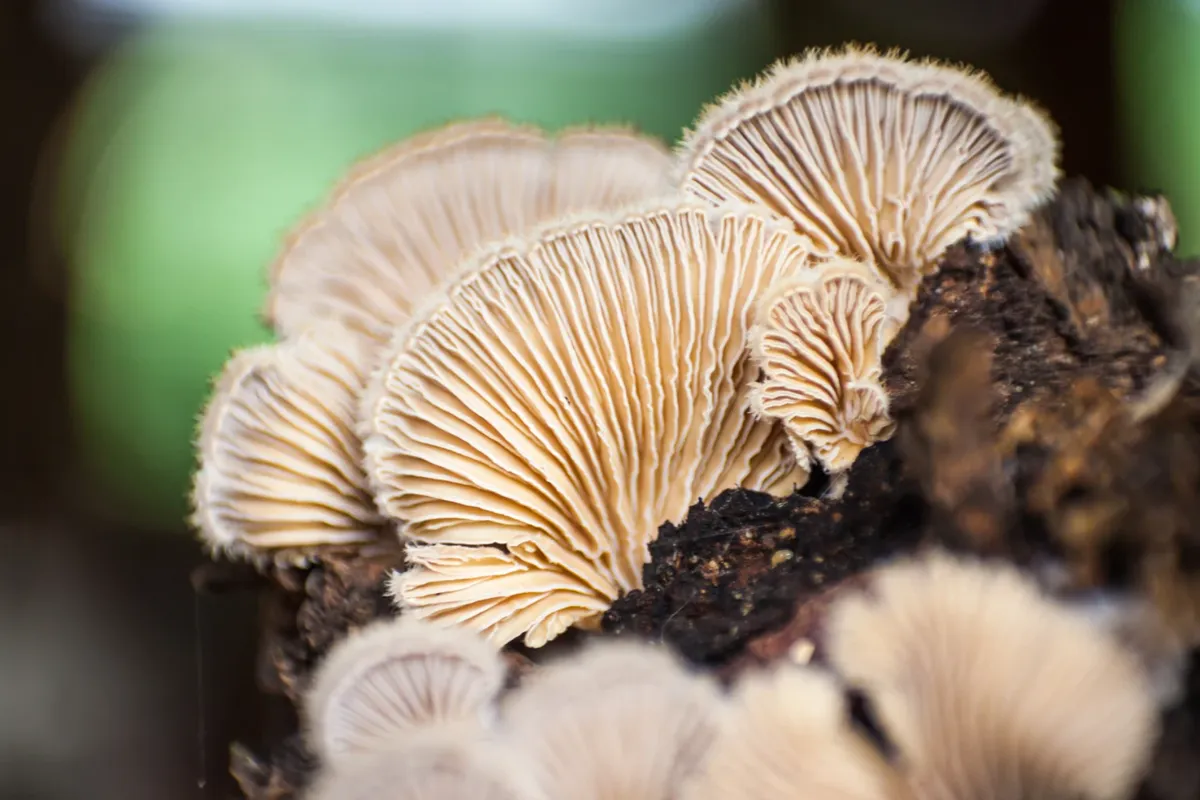
Split Gills, Many Gifts: Split Gill, Schizophyllum commune
Split Gills, Many Gifts: Multipurpose Mushroom of the Week
By: Benjamin Ashpole
Most people walk past the Split Gill mushroom, Schizophyllum commune, without realizing it is such a widespread and medically interesting fungus. Found on dead branches and logs across North America and beyond, this hardy little fan-shaped mushroom has quietly attracted scientists for more than a century. Its name comes from its distinctive “gills,” which are actually folded and split ridges on the underside, like tiny, ruffled pages in a book.

Researchers have found that Split Gill is rich in polysaccharides and other compounds that show antioxidant, antibacterial, antiviral, and immune‑modulating activity in lab and animal studies, though this use remains experimental. Clinical and preclinical work with schizophyllan, a β‑glucan, has been associated with improved immune responses and, in certain gastric and cervical cancer settings, better outcomes when used alongside standard treatment under medical supervision.
Beyond the lab, this unassuming mushroom has helped biologists unlock fundamental genetics. In the mid‑1900s, Schizophyllum commune became a model organism for studying mating systems, with researchers discovering it has tens of thousands of mating types and identifying genes that help control fruiting.
In nature, Split Gill is a dedicated wood recycler, breaking down dead hardwood and returning nutrients to the forest floor. It is also a valued ingredient in traditional dishes in parts of Asia, such as India and Southeast Asia, and in regions like the Himalayas and Borneo. Rare allergies and infections have been reported in people with significant underlying health issues.
For Midwest and wider North American foragers, Split Gill can appear almost any time temperatures are above freezing, but it is most often noticed from late spring through fall when humidity is high and fallen limbs stay damp. The fruiting bodies can persist for many months, drying out and then “reawakening” after rain across multiple seasons.
Home cultivators and researchers have successfully grown Split Gill on sterilized sawdust and supplemented hardwood substrates, using techniques similar to other small wood‑loving mushrooms. Outdoors, it can colonize inoculated hardwood blocks or branches in shaded, moist corners of a yard.
Join The Mushroom Journey
Just remember, this article is not a guide to identifying mushrooms and is not medical advice. Always buy mushrooms from reputable sources, and cook them well. Never eat foraged mushrooms without human‑expert identification. To discover hundreds of native gourmet, functional, and practical mushrooms, or to learn about local foraging events and home‑cultivation guidance, join the free newsletter at NourishCap.com.
Sources Cited
https://www.mushroom-appreciation.com/split-gill-mushrooms.html
https://botit.botany.wisc.edu/toms_fungi/feb2000.html
https://pubmed.ncbi.nlm.nih.gov/40701086/
https://www.science.org/doi/10.1126/science.165.3889.190
https://treefool.com/midwest-mushroom-hunting/


