Local Mushroom of the Week: Lion's Mane, its market, research, safety, and storage
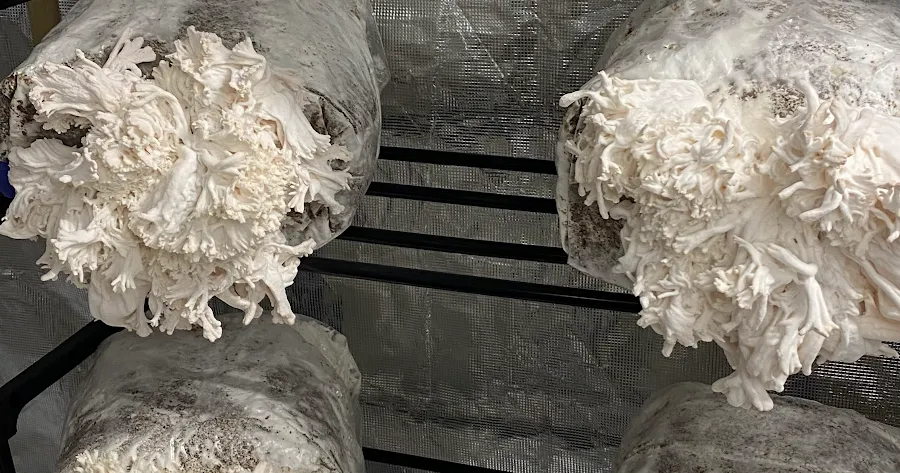
This week's Local Mushroom of the Week is the lion's mane.
Lion's mane now shows up in "coffee, protein bars, gummies, and ready to drink beverages."1 You may find it in drinks, bars, or gummies at larger stores.1 One source on market trends says these products are "getting more shelf space in big retailers," backed by "solid market momentum" in some recent summaries.1 It says interest "seems to be accelerating," driven by "consumers looking for cognition related and immune-supportive foods."1
Here is what the research says.2,3 Across experimental models, lion's mane showed "consistent neuroprotective effects," meaning it helped protect nerve cells.2 In those models, the mushroom demonstrated that nerve-protecting result time after time.2 Researchers pointed to "stimulation of NGF and BDNF," which are NGF (nerve growth factor) and BDNF (brain-derived neurotrophic factor), along with "attenuation of neuronal apoptosis," or less nerve cell death.2 So these are mechanisms seen in experimental models, and benefits for people remain unsettled.2 Limited human studies "currently prevent definitive clinical" conclusions.2 The science of freshness is clearer.2,3 Shelf life is how long mushrooms stay usable in storage, and temperature sets it.3 Mushrooms kept at 20 °C "may have a shelf life of up to 48 h," while those at 2 °C "can remain viable for up to one week."3 Even in the fridge, "microbial proliferation restricts the mushrooms' shelf life to approximately seven days," meaning germs growing on them set the limit.3 Cold storage should give lion's mane more time before it spoils.3
When it comes to lion's mane products, the research offers some guidance.2 Across the human studies, lion's mane was "generally well tolerated."2 Those studies reported "no serious adverse effects," though the authors say this still "calls for supplementary and longer-term data."2 They also advise people to "exercise caution" when selecting commercial preparations.2 If you try lion's mane, it makes sense to choose products carefully, since the authors tie that caution to waiting for products with established safety profiles.2
In one study, light color changed the "specific protein expression patterns" of lion's mane, meaning which proteins it made.4 Researchers turned lion's mane residue into "nano chitin with a high aspect ratio," tiny fibers over 50 times longer than wide.5 The study concluded this may be a starting material for a new gel.5
Remember, this article is not a guide to identifying mushrooms and is not medical advice. Always buy mushrooms from reputable sources, and cook them well. Never eat foraged mushrooms without human-expert identification first. To discover hundreds of native gourmet, functional, and practical mushroom videos, products, and events, join the free newsletter at NourishCap.com.
The flashcards in this article
Sources Cited
Gurung et al., Frontiers in Natural Products 2026 Bioactive constituents of Hericium erinaceus: extraction strategies, health benefits and food applications. https://doi.org/10.3389/fntpr.2026.1872464
Ninyo et al., Food as Medicine 2026 Neuroprotective Effects of Hericium erinaceus: Evidence from Experimental and Clinical Studies: A Systematic Review and Limited Meta-Analysis. https://doi.org/10.53941/fm.2026.100009
Silva et al., Horticulturae 2025 Storage Temperature Effect on Quality and Shelf-Life of Hericium erinaceus Mushroom. https://doi.org/10.3390/horticulturae11020158
Sukdee et al., Frontiers in Fungal Biology 2026 Comparative proteomic analysis reveals the effects of different light spectra on protein expression in Hericium erinaceus mycelium. https://doi.org/10.3389/ffunb.2026.1791721
Liao et al., Polymers 2022 Preparation, Characterization and Gelation of a Fungal Nano Chitin Derived from Hericium erinaceus Residue. https://doi.org/10.3390/polym14030474
Report a problem
Found an inaccuracy or anything we got wrong? Send a report with your email.


