
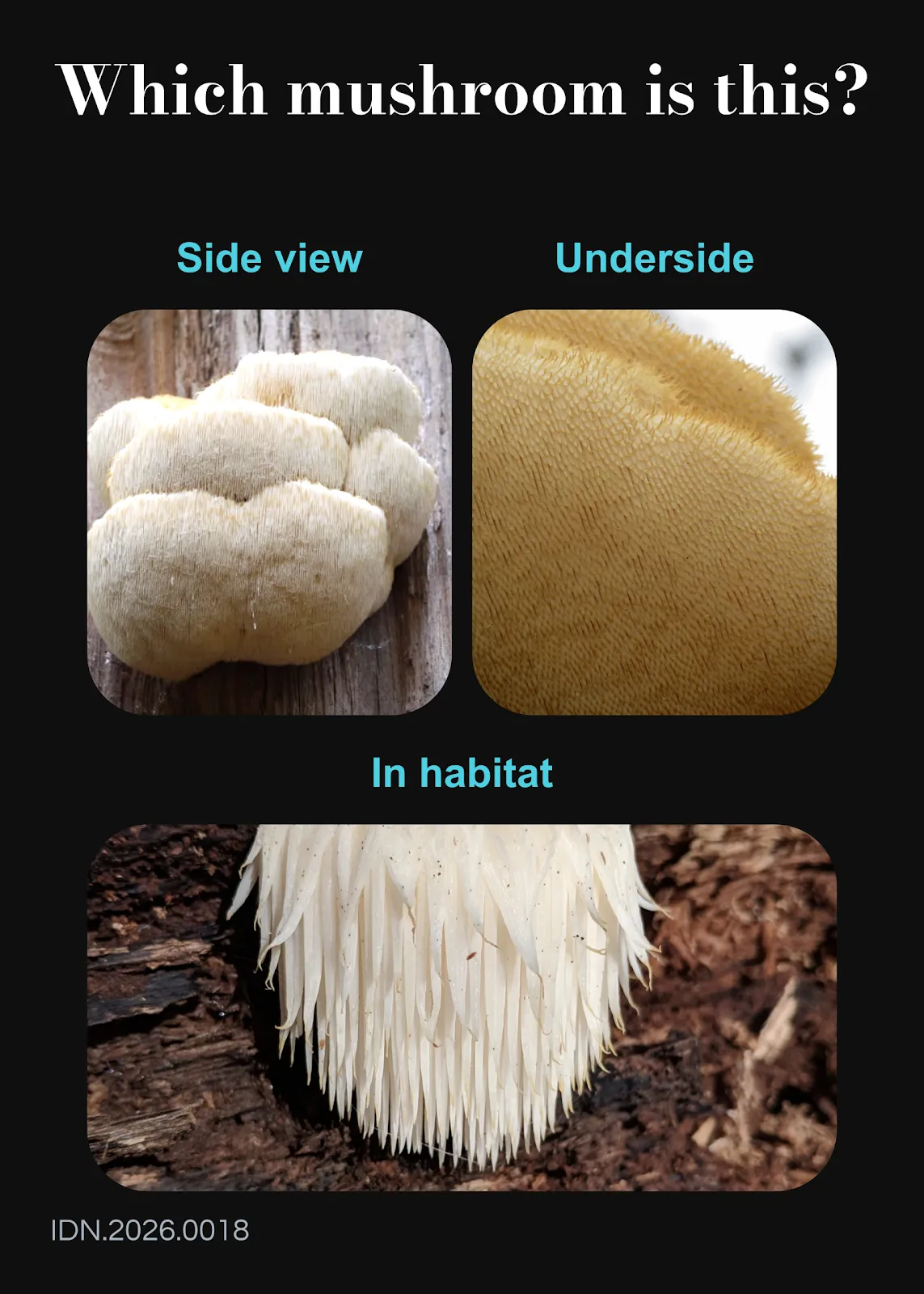
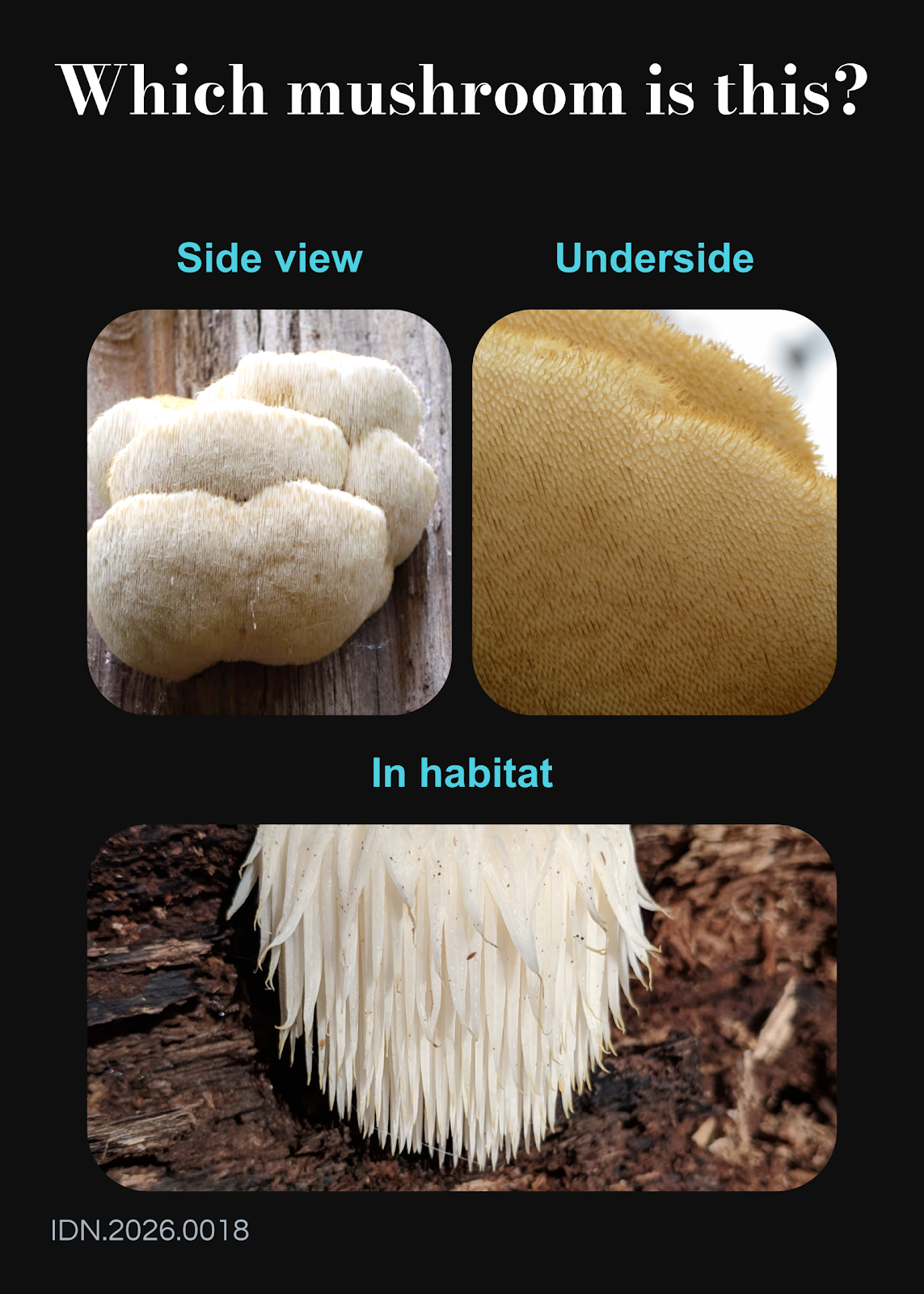
Which mushroom is this?
- Guide
- Three field guides: a Wikimedia photo category, an arborist guide to wood decay fungi, and an English Nature report
- Region
- Western North America, England, and Netherlands photo sites
- Habitat
- Wounded living trees, most often mature beech
- Covers
- Teeth, size, color, season, decay type and a flat lookalike
Flash card
Sources
Source 1
Category: Hericium erinaceus
Wikimedia Commons, Category: Hericium erinaceus
https://commons.wikimedia.org/wiki/Category:Hericium_erinaceus
License: https://creativecommons.org/licenses/by-sa/4.0/
Source 2
Jessie A. Glaeser and Kevin T. Smith (2010), Decay fungi of oaks and associated hardwoods for western arborists, Western Arborist, Winter 2010: 32-46
USDA Forest Service research publications (Treesearch), Jessie A. Glaeser and Kevin T. Smith (2010), Decay fungi of oaks and associated hardwoods for western arborists, Western Arborist, Winter 2010: 32-46 2010
https://research.fs.usda.gov/treesearch/37853
License: Public domain: a government work, written by USDA Forest Service employees (17 U.S.C. 105; Ben's rule ALL-GOVERNMENT-SITES-PUBLIC-DOMAIN); a card quotes its text only, never a photo it credits to someone else (Glaeser and Smith 2010 credit some to mushroomexpert.com, a banned source)
Source 3
Creolophus (= Hericium) cirrhatus, Hericium erinaceus and H. coralloides in England (ENRR492), ENRR492
Natural England publications (Access to Evidence), Creolophus (= Hericium) cirrhatus, Hericium erinaceus and H. coralloides in England (ENRR492), ENRR492
https://publications.naturalengland.org.uk/file/142021
License: Public domain: a government work (Ben's rule ALL-GOVERNMENT-SITES-PUBLIC-DOMAIN): "The information on this site is published by Natural England under the Open Government Licence unless otherwise stated" (https://publications.naturalengland.org.uk/copyright; Open Government Licence v3.0, https://www.nationalarchives.gov.uk/doc/open-government-licence/version/3/, reuse with credit)
How each feature was agreed
| On the card | What the field guides say |
|---|---|
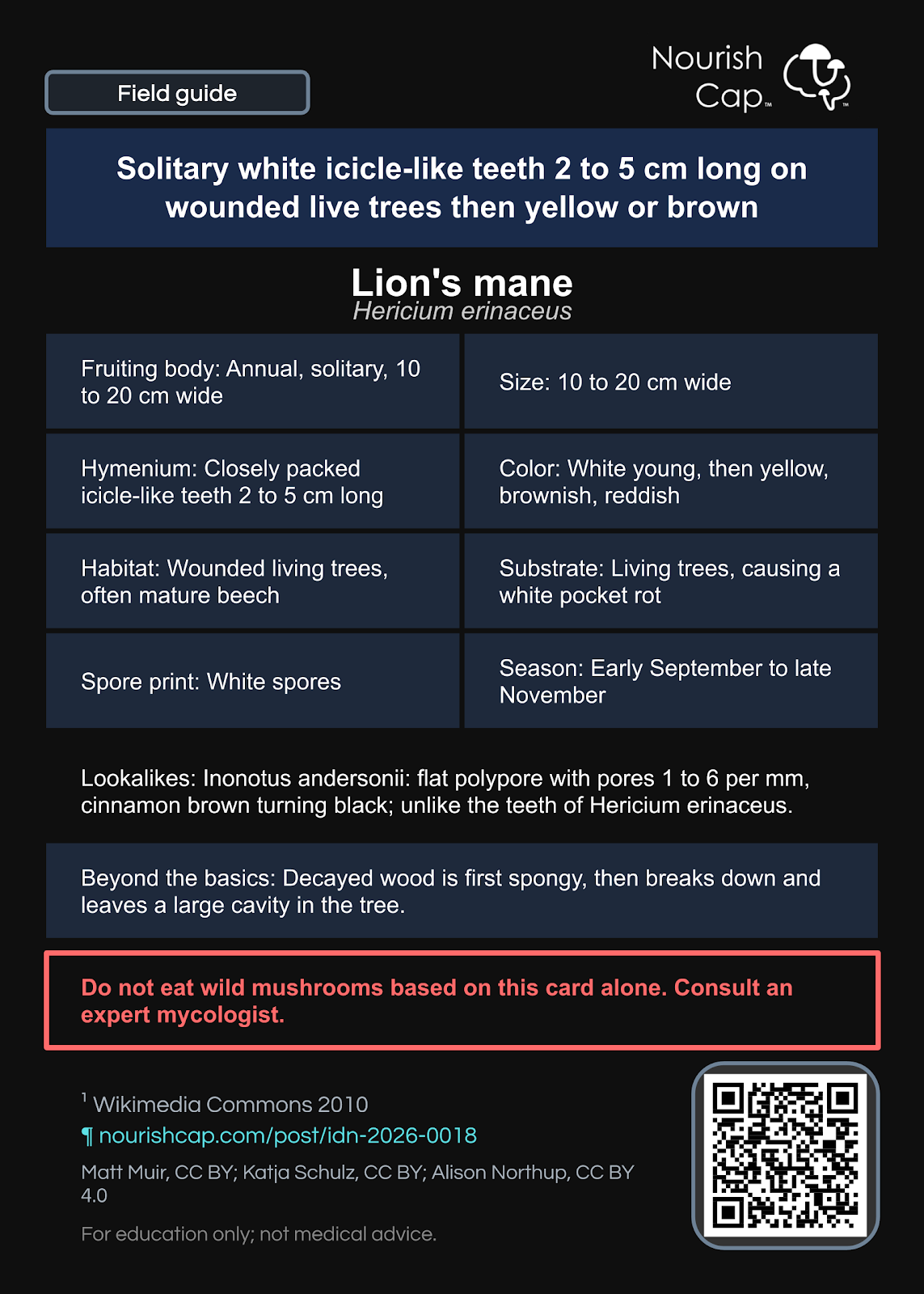
| Fruiting body: Annual, solitary, 10 to 20 cm wide | "Table 2 Description (field characteristics) of Hericium species found in England Character C. cirrhatus H. coralloides H. erinaceus Basidiome form Annual, soft fleshy, up to 25 cm wide, pileate, broadly attached, single or confluent."3 (main text) |
| Hymenium: Closely packed icicle-like teeth 2 to 5 cm long | "Spore-bearing surface consists of many closely-packed, slender, icicle-like teeth 2 – 5 cm long."2 (main text) |
| Habitat: Wounded living trees, often mature beech | "Marren & Dickson (2000) observe that C. cirrhatus is usually found fruiting on cut surf aces and damaged standing trees, sometimes high off the ground; H. coralloides on large fallen logs; and H. erinaceus on living trees that have suffered damage from gales or lightning strikes."3 (main text) "Though records are frequently imprecise, C. cirrhatus , H. coralloides and H. erinaceus seem to be found fruiting most commonly in mature woodlands on b eech, with a long history of tree coverage, a range of tree age classes and retained dead wood."3 (main text) |
| Spore print: White spores | "Detail of a very young Hericium erinaceus (Bearded Tooth or Lion's Mane Mushroom, D= Igel-Stachelbart or Löwenmähne, F= Hydne hérisson, NL= Pruikzwam) white spores and causes white rot, at Wolfheze - panoramio."1 (Media in category "Hericium erinaceus") |
| Size: 10 to 20 cm wide | "Table 2 Description (field characteristics) of Hericium species found in England Character C. cirrhatus H. coralloides H. erinaceus Basidiome form Annual, soft fleshy, up to 25 cm wide, pileate, broadly attached, single or confluent."3 (main text) |
| Color: White young, then yellow, brownish, reddish | "Teeth are white when young becoming yellow, brownish, or sometimes reddish with age."2 (main text) "Developing and by touching damaged (yellow coloured) Hericium erinaceus (Bearded Tooth or Lion's Mane Mushroom, D= Igel-Stachelbart or Löwenmähne, F= Hydne hérisson, NL= Pruikzwam) white spores and causes white rot a - panoramio."1 (Media in category "Hericium erinaceus") |
| Substrate: Living trees, causing a white pocket rot | "Causes a white spongy mottled heartrot of living trees; continues to fruit on dead stumps and logs (Binion et al., 2008; Gilbertson and Ryvarden, 1986)."2 (main text) "Marren & Dickson (2000) observe that C. cirrhatus is usually found fruiting on cut surf aces and damaged standing trees, sometimes high off the ground; H. coralloides on large fallen logs; and H. erinaceus on living trees that have suffered damage from gales or lightning strikes."3 (main text) |
| Season: Early September to late November | "The fruiting season of C. cirrhatus starts in mid-July while H. coralloides and H. erinaceus start in early September, all three continuing until late-November, with a few records at other times of the year."3 (main text) "The season for H. coralloides and H. erinaceus is narrower extending from early September to late-November, though there are also a few records at other times of the year (Fig. 4)."3 (main text) |
| Lookalikes: Inonotus andersonii: flat polypore with pores 1 to 6 per mm, cinnamon brown turning black; unlike the teeth of Hericium erinaceus. | "Inonotus andersonii (= Poria andersonii )– A resupinate (flat) polypore that forms sheet-like fruiting bodies on dead wood underneath the bark and sometimes between outer layers of the sapwood."2 (main text) "Fruiting bodies initially cinnamon brown but become black with age, usually 0.3 – 1.0 m long."2 (main text) "Spore-bearing surface consists of many closely-packed, slender, icicle-like teeth 2 – 5 cm long."2 (main text) |
| Beyond the basics: Decayed wood is first spongy, then breaks down and leaves a large cavity in the tree. | "Wood with advanced decay is yel -low-white, soft and spongy, and frequently contains brown to black zone lines."2 (main text) "Infections in a young tree can produce a cascade of processes that result in long-standing decay and cavities in large, mature individuals."2 (main text) "The amount of decayed wood and the size of the wood cavities are important criteria to consider during hazard tree assessments."2 (main text) |
What you can trust
| Card | Straight from the source |
|---|---|
| Which mushroom is this? | "2 late Hericium erinaceus (Bearded Tooth, D= Igel-Stachelbart, NL= Pruikzwam) near Airborne cemetry Oosterbeek at 19 December 2014 - panoramio."1 (Media in category "Hericium erinaceus") |
| Solitary white icicle-like teeth 2 to 5 cm long on wounded live trees then yellow or brown | "Spore-bearing surface consists of many closely-packed, slender, icicle-like teeth 2 – 5 cm long."2 (main text) "Teeth are white when young becoming yellow, brownish, or sometimes reddish with age."2 (main text) "Marren & Dickson (2000) observe that C. cirrhatus is usually found fruiting on cut surf aces and damaged standing trees, sometimes high off the ground; H. coralloides on large fallen logs; and H. erinaceus on living trees that have suffered damage from gales or lightning strikes."3 (main text) |
The limits, stated plainly
- Spore print. The guides only say the mushroom has white spores and causes white rot; they give no spore print method or spore measurements.
- Size. The size of 10 to 20 cm comes from the arborist guide only; the English report's table row is cut off in the text.
- Lookalikes. Only one lookalike, a flat polypore, is compared; other toothed mushrooms are not covered.
- Edibility. Identification is the focus; young fruiting bodies are noted as edible but may cause allergic reactions.
- Season. Season dates come from English records; a few records fall outside, and other regions are not covered.
- Host range. Most English records are on beech, but records often lack detail on whether the host was standing or fallen.
- Taxonomy. The English report notes some confusion in the classification of the genus, which may need DNA studies.
- Photo category. The photo captions give names and places, not full descriptions.
- Not medical advice.
What the labels on the card mean
Plain-word definitions
- Hericium erinaceus. The scientific name of lion's mane, a white mushroom with long hanging teeth that grows on trees.
- Hymenium. The spore-bearing surface; here it is made of many icicle-like teeth.
- Polypore. A mushroom that releases spores from small pores instead of gills or teeth.
- Resupinate. Flat, lying against the wood like a sheet.
- White rot. Decay that breaks down wood and leaves it pale.
- Pocket rot. A kind of decay that makes many small pockets in the wood.
- Spongy rot. Decayed wood that is soft and spongy.
- Annual. A fruiting body that lasts only one season.
- Spore print. The color of spores collected as a deposit; here white.
Spot something wrong?
Found an inaccuracy or anything we got wrong? Send a report with your email.
Get every new card by email
New cards and the research behind them, once a week. Join over 1,500 readers. No hype, unsubscribe anytime.
This page summarizes a published source; we did not conduct this research. Wording is our editorial compression. Where our summary differs from the source, the source governs.
This page is for education only and is not medical advice. Talk to your clinician before changing anything about your health routine. Dietary supplements are not evaluated by the FDA to treat, prevent, or cure any disease. Results describe the study's participants, not a promise of your outcome. Read the limitations before acting on anything here.
Photo on the card: Matt Muir, CC BY, via iNaturalist (edited); Katja Schulz, CC BY, via iNaturalist; Alison Northup, CC BY 4.0, via Wikimedia Commons. For education only; not medical advice.


