
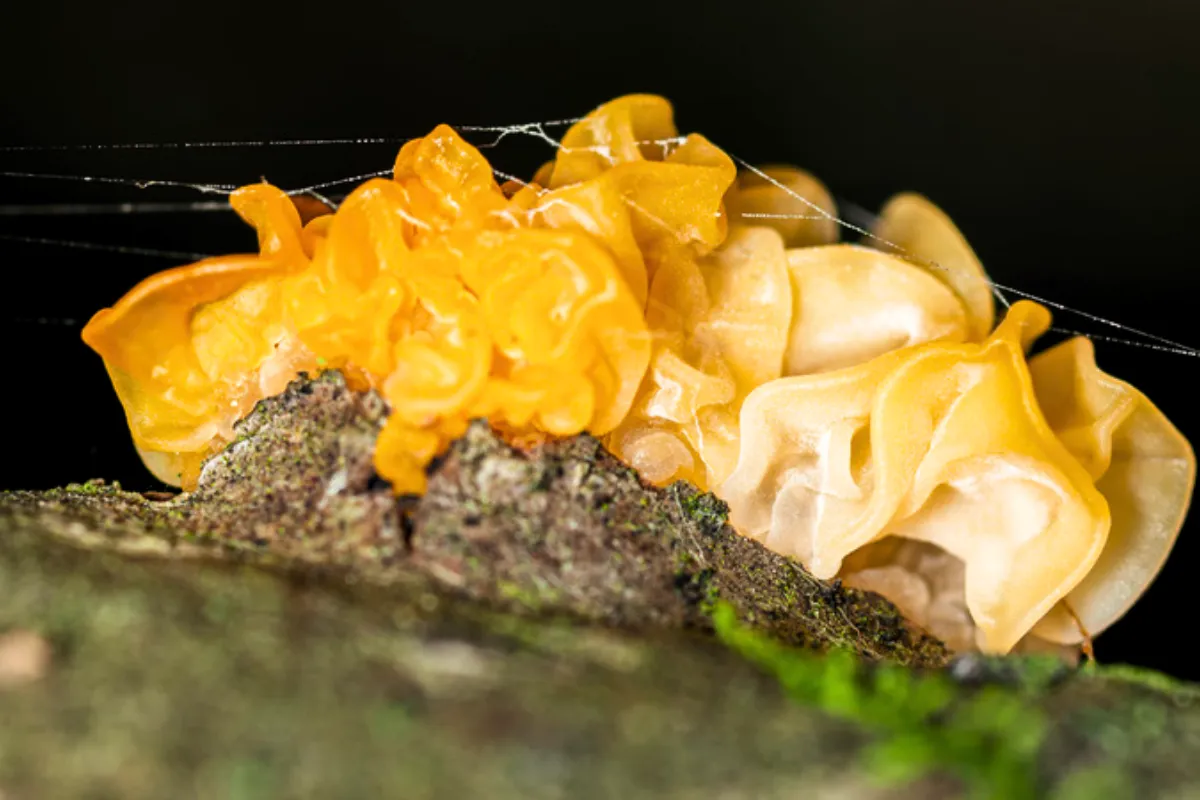
Golden Treasure: Witch's Butter, Tremella mesenterica
Golden Treasure: Multipurpose Mushroom of the Week
By: Benjamin Ashpole, Oli Genn-Bash
When Midwesterners think about natural resources, they usually envision lakes and forests. But there's a brilliant golden treasure hiding on fallen branches right in our backyards that most Hoosiers walk past without a second glance. Witch's Butter, scientifically known as Tremella mesenterica, is a gelatinous jelly fungus that thrives throughout Indiana's deciduous forests, yet remains virtually unknown in our region despite being widespread across North America.

This striking mushroom looks like a blob of bright orange or yellow jelly clinging to dead oak, beech, and other hardwood branches. Witch's Butter can be found year-round, though it fruits most abundantly during fall and winter months when rain or thaws bring it back to life after dry periods. Its remarkable ability to shrivel into a thin film during dry weather and rehydrate after rainfall makes it particularly resilient to our region's unpredictable climate.
While Tremella mushrooms have been celebrated in Asian traditional medicine for centuries, most historical and scientific research focuses on a similar species—Tremella fuciformis (Snow Fungus)—rather than our local T. mesenterica. However, Tremella mesenterica has its own scientifically documented benefits that make it worthy of attention.
Modern research specifically on T. mesenterica has confirmed several medicinal properties. Studies document that this mushroom contains glucuronoxylomannan and polysaccharides demonstrating immunostimulating, antidiabetic, anti-inflammatory, hypocholesterolemic, hepatoprotective, and antiallergenic effects. Research shows these compounds stimulate immune function by enhancing macrophage activity and modulating immunity in animal studies. A clinical trial examined T. mesenterica for treating Helicobacter pylori infections and found that while it didn't eradicate the bacteria, patients taking T. mesenterica experienced equivalent symptomatic relief compared to standard triple therapy, with significantly fewer adverse effects.[10][11][12][13]
Unlike its Asian cousin T. fuciformis, which is widely cultivated and sold in markets, T. mesenterica is primarily a foraged mushroom with virtually no commercial availability. Foragers describe it as having little to no taste, though some report a cooling, menthol-like sensation when tasted raw—a tingling effect similar to the feeling of Vicks VapoRub or menthol. It's valued mainly for its unique gelatinous texture and can be added to soups and stews where it absorbs surrounding flavors. Some creative foragers candy it in maple syrup, then dehydrate it into homemade gummy treats.
Peak foraging months in Northern Indiana are October through March, particularly after autumn rains and during mild winter wet periods when this resilient fungus emerges on dead hardwood branches. Growing Witch's Butter at home requires both hardwood logs and a host fungus (Peniophora species) that must colonize the wood first, making cultivation quite challenging.
Remember, proper identification by an expert is essential before consuming any wild mushroom. Only eat one new mushroom species per day, and always cook wild varieties thoroughly.
Join The Mushroom Journey
To learn about more fascinating native species hiding in our local woods each week, join the free newsletter at NourishCap.com.


