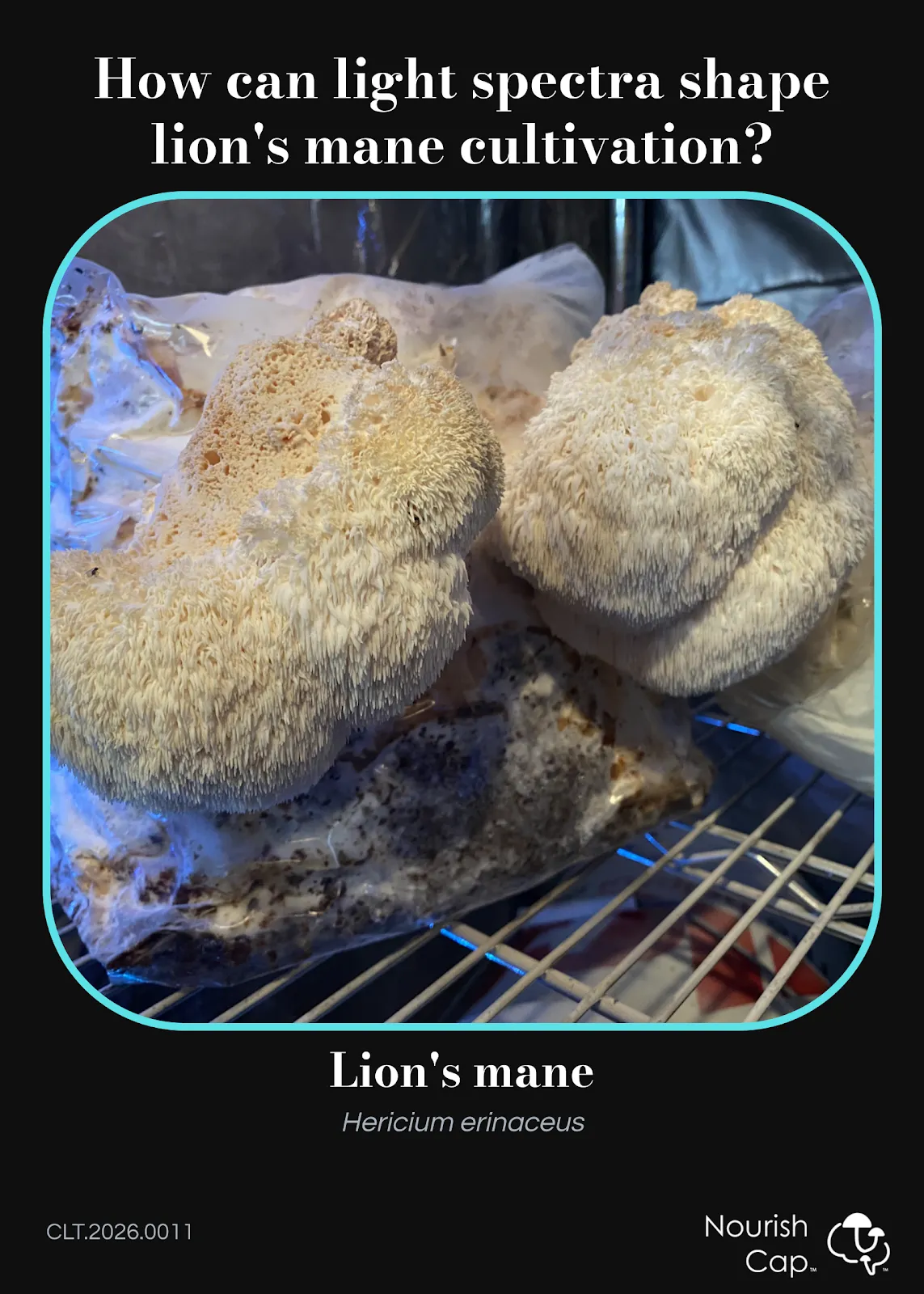
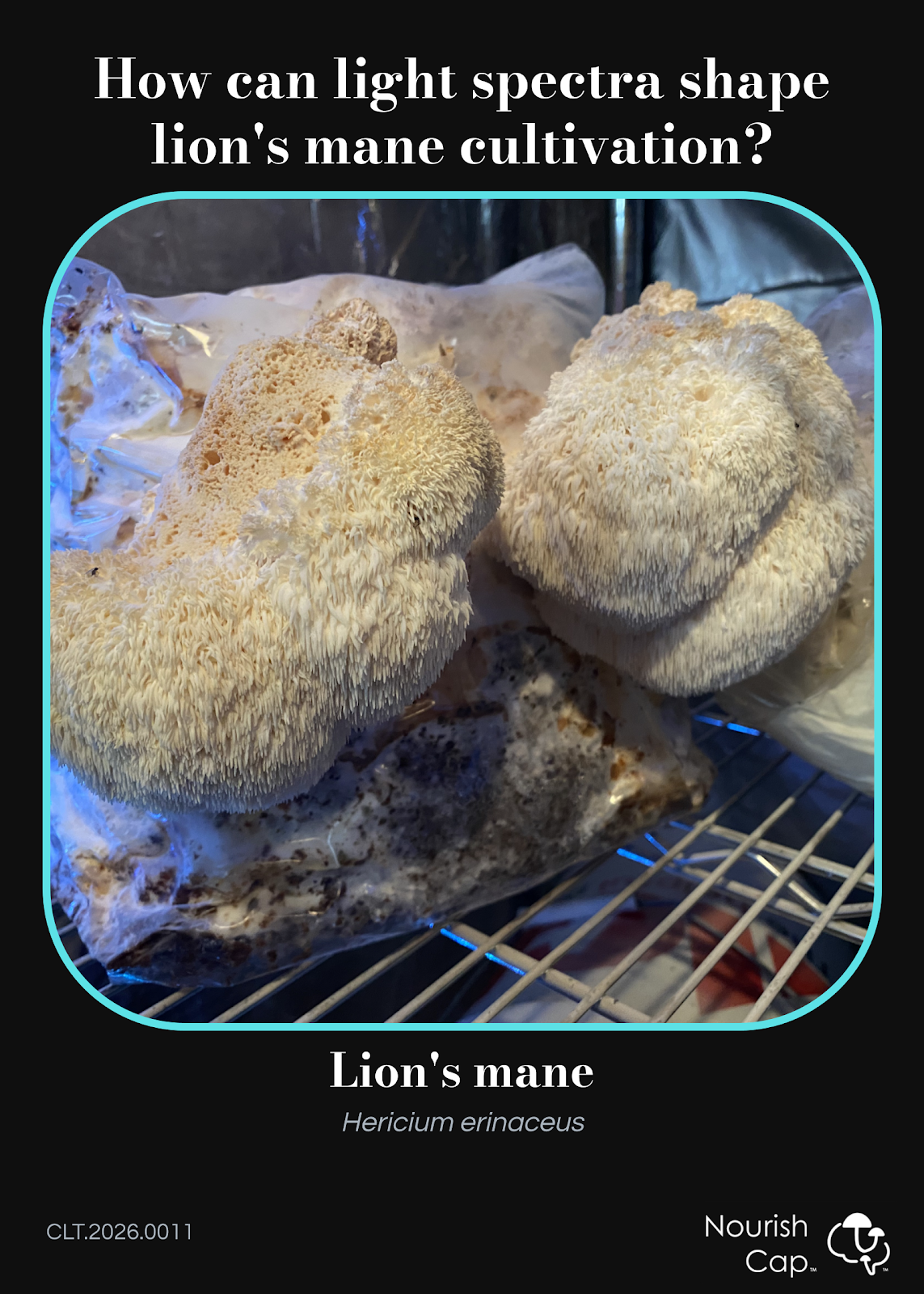
How can light spectra shape lion's mane cultivation?
- Design
- Comparative proteomic analysis
- Samples
- Hericium erinaceus mycelium cultured for 15 days
- Conditions
- Darkness control versus blue, green, red, and RGB LED light treatments
- Measured
- Global protein expression profiles, differentially expressed proteins (DEPs), and pathway enrichment
Flash card
The source
Source 1
Comparative proteomic analysis reveals the effects of different light spectra on protein expression in Hericium erinaceus mycelium
Sukdee et al., Frontiers in Fungal Biology 2026
DOI: 10.3389/ffunb.2026.1791721
Funding: the paper declares a possible conflict of interest: The author(s) declared that this work was conducted in the absence of any commercial or financial relationships that could be construed as a potential conflict of interest.
Open access. Excerpts are drawn from the published full text.
The study, in plain words
- Strain Source. Isolated from fresh fruiting bodies cultivated at Thammasat University, Thailand
- Incubation. Inoculated cultures incubated in darkness at 25 °C for 3 days prior to light treatments
- Light Treatments. Exposed to blue (450 nm), green (520 nm), red (660 nm), and RGB LED qualities at 40 µmol m^-2s^-1 for 8 hours daily over 15 days
- Control Group. Cultures maintained in complete darkness
- Biomass Collection. Mycelia harvested by scraping the solid medium surface, then frozen at -80 °C
- Proteomics. Label-free LC-MS/MS quantitative proteomics used to identify and quantify protein expression profiles
- Data Analysis. Gene Ontology (GO) and Kyoto Encyclopedia of Genes and Genomes (KEGG) databases used for functional annotation and pathway enrichment
The source's own bottom line
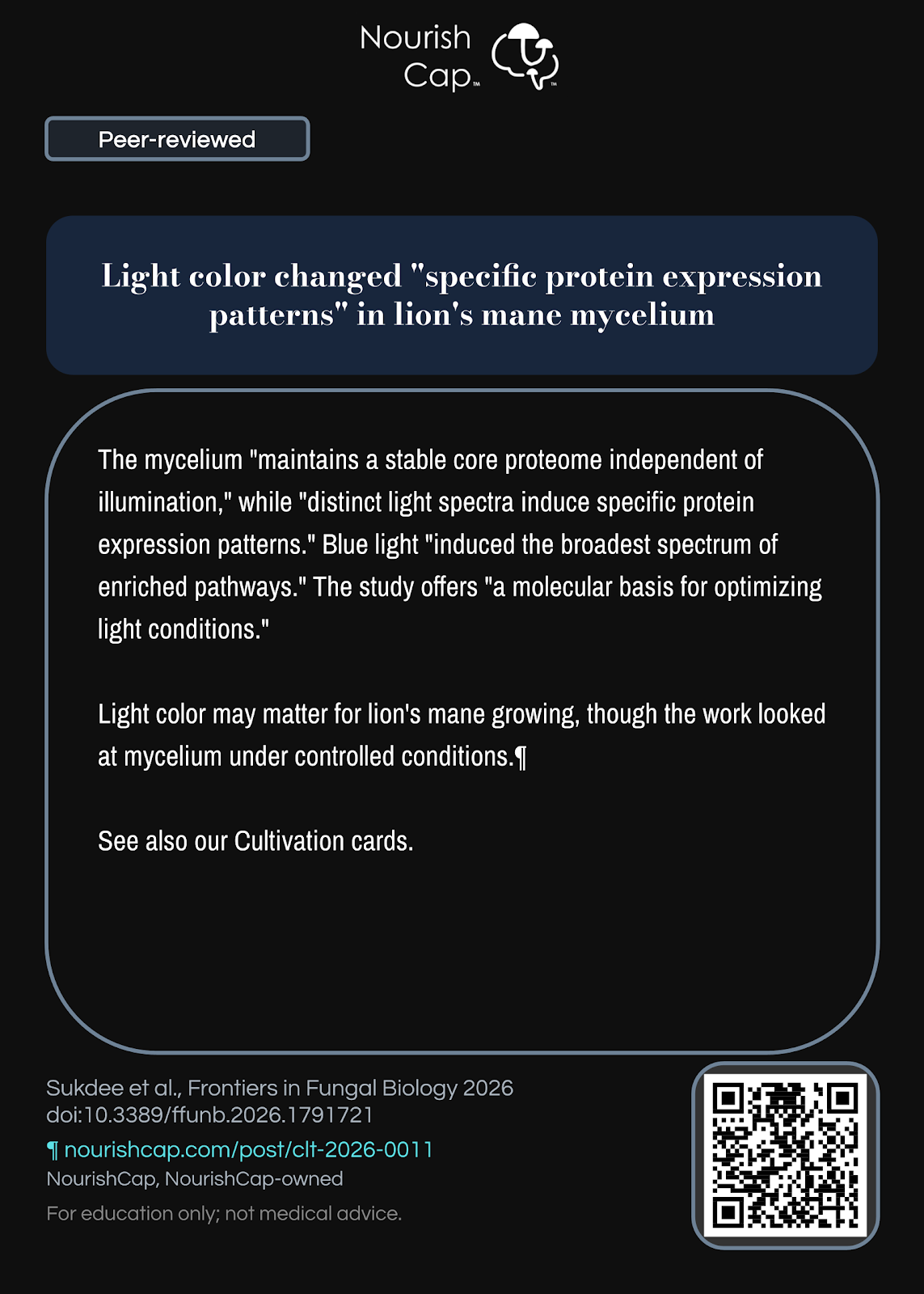
The study found that while the mycelium maintains a stable core proteome independent of illumination, distinct light spectra induce specific protein expression patterns, with blue light inducing the broadest spectrum of enriched pathways.
The authors reported that light acts as a potent informational signal that reprograms the fungal proteome in a wavelength-dependent manner while maintaining a conserved core set of proteins associated with vegetative growth.
The researchers concluded that the work offers a molecular basis for optimizing light conditions in controlled cultivation systems aimed at improving biomass production and functional metabolite biosynthesis in medicinal mushrooms.
What you can trust
| Card | Straight from the source |
|---|---|
| How can light spectra shape lion's mane cultivation? | "Comparative proteomic analysis reveals the effects of different light spectra on protein expression in Hericium erinaceus mycelium"1 () "erinaceus responds to light at the molecular level, particularly focusing on the proteomic changes induced by exposure to various light wavelengths."1 (Introduction) |
| Light color changed "specific protein expression patterns" in lion's mane mycelium | "erinaceus maintains a stable core proteome independent of illumination; distinct light spectra induce specific protein expression patterns."1 (Results) |
| The mycelium "maintains a stable core proteome independent of illumination", while "distinct light spectra induce specific protein expression patterns". | "erinaceus mycelia growing under different light treatments, including blue, green, red, and RGB qualities, compared to control (darkness)."1 (Abstract) "erinaceus maintains a stable core proteome independent of illumination; distinct light spectra induce specific protein expression patterns."1 (Results) |
| Blue light "induced the broadest spectrum of enriched pathways". | "Comparative proteomic analysis under different light treatments revealed 550–677 DEPs per condition, with the blue-light treatment exhibiting the greatest number of uniquely expressed proteins."1 (Abstract) "Blue light induced the broadest spectrum of enriched pathways, particularly within metabolic processes."1 (Results) |
| The study offers "a molecular basis for optimizing light conditions". | "These results support the molecular-mechanistic approach employed and offer valuable insights into protein expression dynamics and regulatory pathways, while also clarifying how different light qualities influence the developmental processes of H."1 (Abstract) "This study advances fundamental understanding of fungal photobiology in basidiomycetes and provides a molecular basis for optimizing light conditions in controlled cultivation systems aimed at improving biomass production and functional metabolite biosynthesis in medicinal mushrooms."1 (Conclusion) |
| Light color may matter for lion's mane growing, though the work looked at mycelium under controlled conditions.¶ See also our Cultivation cards. | "The inoculated cultures were then incubated at 25 ± 1 °C under either dark or controlled light conditions for 3 days prior to LED light treatments."1 (Materials and methods) "The experiment consisted of 4 light treatments - blue light (BL; wavelength 450 nm), green light (GR; wavelength 520 nm), red light (RD; wavelength 660 nm), and a combination of red, green, and blue light (RGB) ([^Supplementary Figure 1]) - along with a control treatment (CT; darkness) where the cultures were maintained in complete darkness."1 (Materials and methods) "Consequently, the light-responsive proteomic patterns observed here likely represent baseline regulatory responses under nutrient-sufficient conditions rather than the full adaptive capacity of the fungus in ecologically or industrially relevant environments."1 (Discussion) |
The limits, stated plainly
- Nutrient Medium. All experiments were conducted exclusively on potato dextrose agar, a nutrient-rich synthetic medium that does not reflect natural or commercial lignocellulosic substrates.
- Developmental Stage. The investigation focused solely on the vegetative mycelial stage rather than fruiting body formation.
- Environmental Scope. Conditions were restricted to controlled laboratory settings rather than ecologically complex natural environments.
- Not medical advice.
Retraction watch
Last checked 2026-11-02: no retraction notice, correction, or expression of concern appears on Crossref, OpenAlex and PubMed.
What the labels on the card mean
Plain-word definitions
- Hericium erinaceus. A medicinal mushroom species, commonly known as lion's mane, whose mycelium was evaluated in the study.
- Mycelium. The vegetative network of fungal hyphae that grows through a substrate.
- Proteomics. The large-scale study of proteins, particularly their structures and functions.
- Differentially expressed proteins (DEPs). Proteins whose abundance changes significantly in response to different experimental conditions or treatments.
- Photoreceptor. A specialized protein molecule that detects and responds to specific wavelengths of light.
- Carbohydrate-active enzymes (CAZymes). Enzymes that build, modify, or break down complex carbohydrates and polysaccharides.
Spot something wrong?
Found an inaccuracy or anything we got wrong? Send a report with your email.
Get every new card by email
New cards and the research behind them, once a week. Join over 1,500 readers. No hype, unsubscribe anytime.
This page summarizes a published source; we did not conduct this research. Wording is our editorial compression. Where our summary differs from the source, the source governs.
This page is for education only and is not medical advice. Talk to your clinician before changing anything about your health routine. Dietary supplements are not evaluated by the FDA to treat, prevent, or cure any disease. Results describe the study's participants, not a promise of your outcome. Read the limitations before acting on anything here.
Photo on the card: NourishCap, NourishCap-owned. For education only; not medical advice.


