
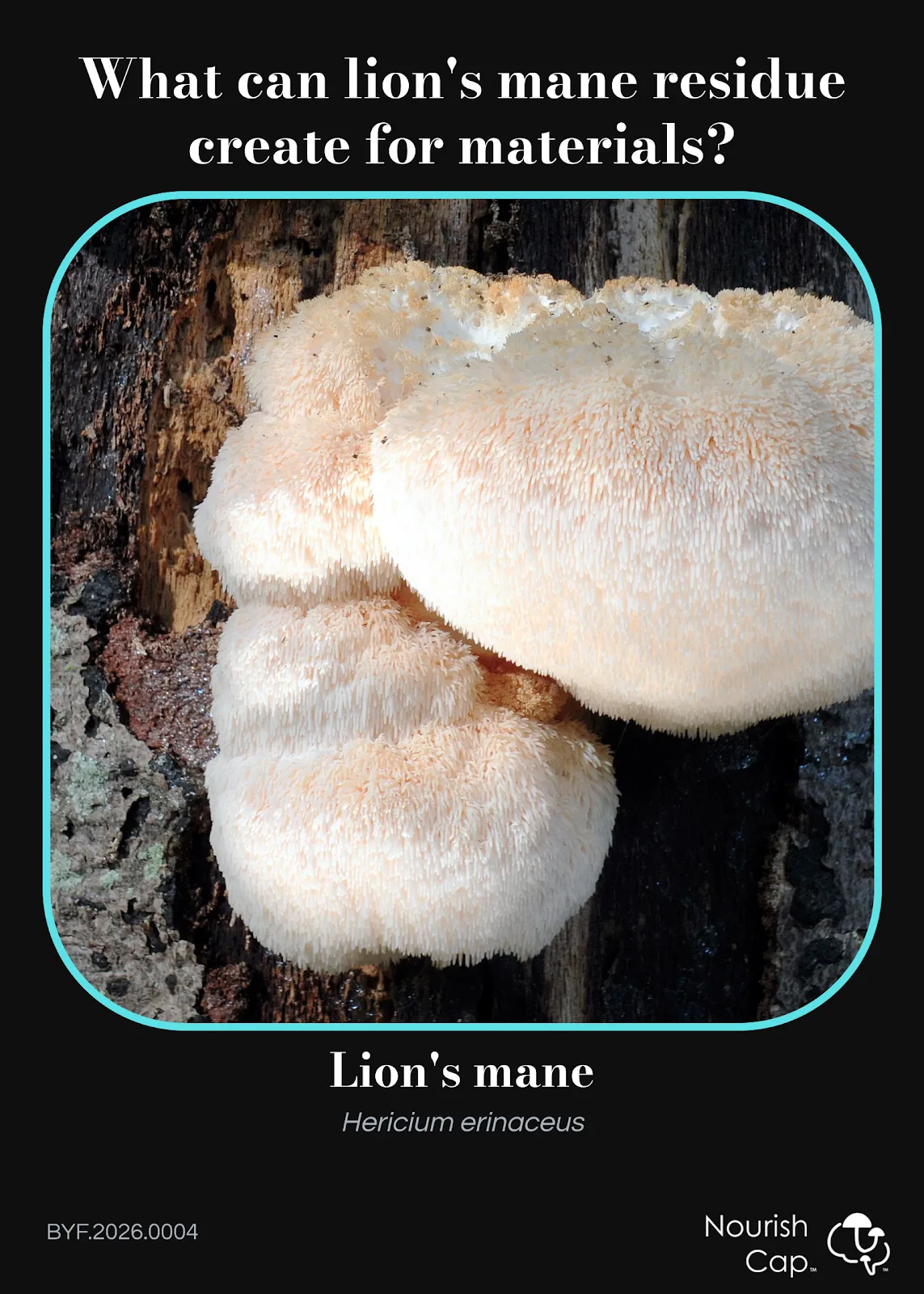
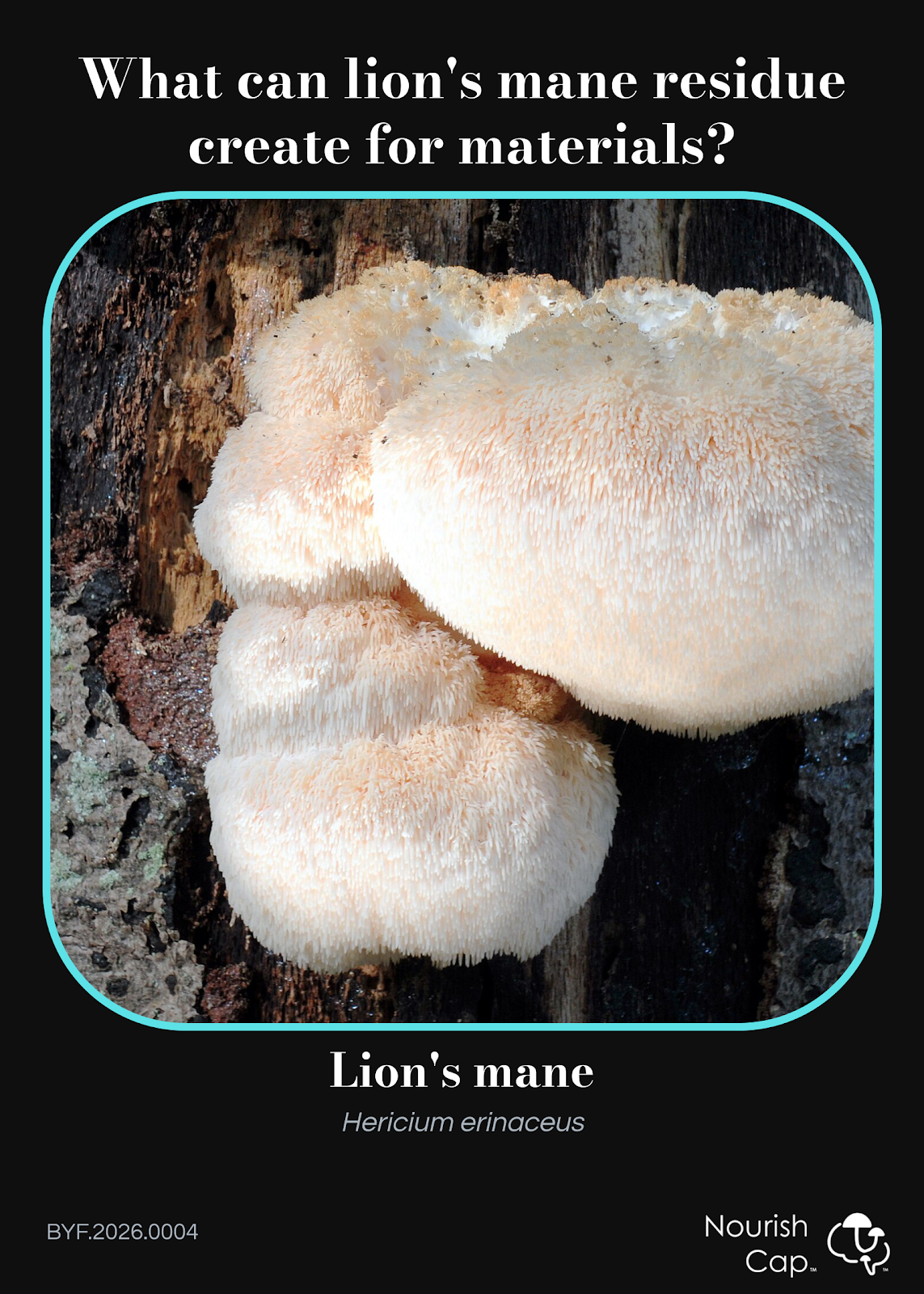
What can lion's mane residue create for materials?
- Design
- Extraction of fungal chitin from mushroom processing residue, followed by TEMPO-mediated oxidation and acid-induced gas phase coagulation.
- Samples
- Residue collected from the waste obtained after the extraction of polysaccharides from Hericium erinaceus fruiting bodies.
- Conditions
- Mineral and protein purification steps at room temperature and elevated temperatures, followed by oxidation and exposure to acetic acid vapor.
- Measured
- Morphology, dimensions, crystallization index, thermal stability, dispersion stability, apparent viscosity, light transmittance, and gelation ability.
Flash card
The source
Source 1
Preparation, Characterization and Gelation of a Fungal Nano Chitin Derived from Hericium erinaceus Residue
Liao et al., Polymers 2022
Open access. Excerpts are drawn from the published full text.
The study, in plain words
- Mineral Removal. Dispersed raw mushroom residue into a 4 weight percent hydrogen chloride aqueous solution at room temperature for 12 hours.
- Protein Removal. Washed the residue to neutral and dispersed it into a 2 weight percent sodium hydroxide aqueous solution at 85 degrees Celsius for 3 hours.
- Purification. Washed the collected residue to neutral and dispersed it in a 7.5 weight percent sodium chlorite aqueous solution at 75 degrees Celsius for 2 hours to obtain fungal chitin.
- Oxidation. Suspended powdered fungal chitin in water containing TEMPO and sodium bromide, initiated the reaction with sodium hypochlorite, and maintained the pH at 10.
- Washing and Sonication. Centrifuged and washed the oxidized precipitate multiple times, resuspended it in distilled water, and treated it with ultrasound for 10 minutes.
- Gel Preparation. Poured nano chitin dispersions with concentrations ranging from 0.2 to 0.8 weight percent into small petri dishes and exposed them to acetic acid vapor overnight.
The source's own bottom line
The study found that leftover residue from lion's mane mushroom polysaccharide extraction can be successfully converted into a fungal-derived nano chitin with a high aspect ratio exceeding 50 to 1.
The authors reported that the prepared nano chitin dispersions exhibited desirable gelation ability and were converted into stable hydrogels under acetic acid vapor through enhanced hydrogen bond crosslinking.
The authors concluded that nano chitin prepared from this mushroom residue may serve as a promising starting material for natural polymer hydrogels with potential applications in tissue engineering, drug delivery, and pollutant removal.
What you can trust
| Card | Straight from the source |
|---|---|
| What can lion's mane residue create for materials? | "Preparation, Characterization and Gelation of a Fungal Nano Chitin Derived from Hericium erinaceus Residue"1 () |
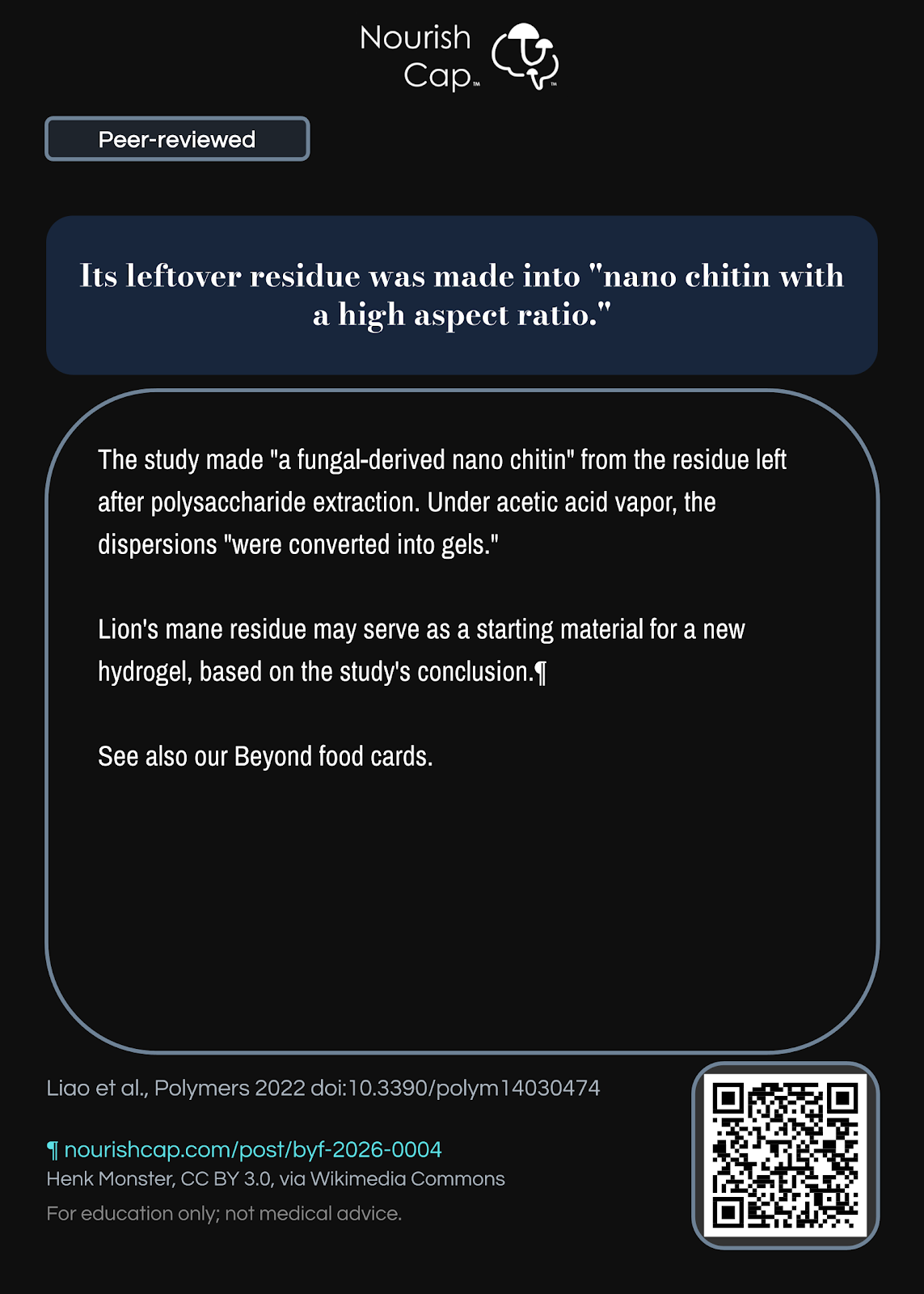
| Its leftover residue was made into "nano chitin with a high aspect ratio". | "The results showed that the average length and width of the prepared fungal nano chitin were 336.6 nm and 6.4 nm, respectively, and the aspect ratio exceeded 50:1."1 (Abstract) "Therefore, nano chitin with a high aspect ratio was successfully prepared from the Hericium erinaceus residue."1 (3. Results and Discussion) |
| The study made "a fungal-derived nano chitin" from the residue left after polysaccharide extraction. | "In this work, a fungal-derived nano chitin was prepared from Hericium erinaceus residue via mineral/protein purification and subsequent TEMPO-mediated oxidation."1 (Abstract) "After the extraction of polysaccharides, the remained Hericium erinaceus residue can still be used for chitin extraction."1 (1. Introduction) |
| Under acetic acid vapor, the dispersions "were converted into gels". | "Under acetic acid “gas phase coagulation”, the prepared nano chitin dispersions with mass concentrations of 0.2, 0.4, 0.6, and 0.8% were converted into gels by enhanced hydrogen bond crosslinking between nano chitins."1 (Abstract) |
| Lion's mane residue may serve as a starting material for a new hydrogel, based on the study's conclusion.¶ See also our Beyond food cards. | "Based on the above results, nano chitin prepared from Hericium erinaceus residue can be regenerated from the nano dispersed state into a new natural polymer hydrogel by the acid-induced gas phase coagulation method."1 (3. Results and Discussion) "Therefore, similar to other natural polysaccharide gels, the prepared nano chitin gels may serve as a promising candidate for a wide range of applications, such as tissue engineering, drug delivery, and pollutant removal."1 (4. Conclusions) |
The limits, stated plainly
- Mechanical Strength. The study noted that the prepared nano chitin gels were fragile in a swollen state.
- In Vivo Testing. The study did not perform biological or biomedical experiments involving living tissue or animals.
- Drug Loading. The study did not test the actual loading or release performance of pharmaceutical compounds using the hydrogels.
- Not medical advice.
Retraction watch
Last checked 2026-11-02: no retraction notice, correction, or expression of concern appears on Crossref, OpenAlex and PubMed.
What the labels on the card mean
Plain-word definitions
- Hericium erinaceus. A mushroom species commonly known as lion's mane, used in this study as a resource for extracting fungal polysaccharides and chitin residue.
- Nano chitin. A highly crystalline, nanoscale derivative of chitin possessing a high aspect ratio and a large surface area.
- Aspect ratio. The proportional relationship between an object's length and its width.
- TEMPO-mediated oxidation. A chemical modification method used to introduce carboxylate groups onto the surface of chitin crystallites without complex equipment.
- Gas phase coagulation. A method where liquid dispersions are exposed to an acidic vapor phase to induce crosslinking and transform the liquid into a gel.
- Zeta potential. A measurement of the electrostatic charge on the surface of suspended particles that indicates colloidal dispersion stability.
Spot something wrong?
Found an inaccuracy or anything we got wrong? Send a report with your email.
Get every new card by email
New cards and the research behind them, once a week. Join over 1,500 readers. No hype, unsubscribe anytime.
This page summarizes a published source; we did not conduct this research. Wording is our editorial compression. Where our summary differs from the source, the source governs.
This page is for education only and is not medical advice. Talk to your clinician before changing anything about your health routine. Dietary supplements are not evaluated by the FDA to treat, prevent, or cure any disease. Results describe the study's participants, not a promise of your outcome. Read the limitations before acting on anything here.
Photo on the card: Henk Monster, CC BY 3.0, via Wikimedia Commons. For education only; not medical advice.


