Local Mushroom of the Week, Ringless Honey, The Shapeshifter In Your Yard
Benjamin Ashpole
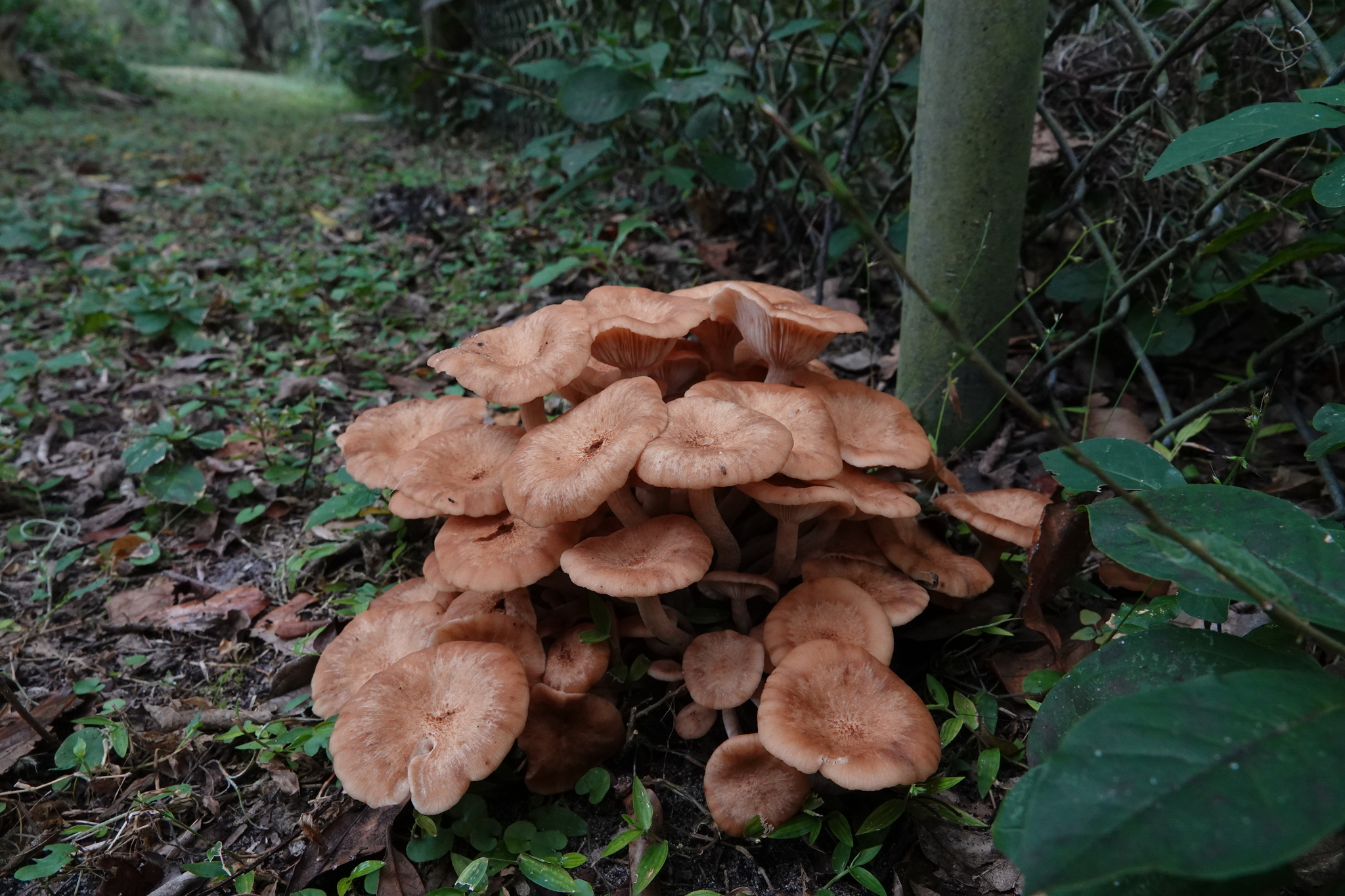
Residents of North America might be surprised to find an aggressive forest apex predator that culls weak trees, the Ringless Honey, currently lurking in their lawns. Known scientifically as Desarmillaria caespitosa, this native North American powerhouse hides a bizarre secret. It is often the victim of an "attack" by a parasitic fungus that hijacks its genetic programming during its earliest growth stage. This biological takeover causes the mushroom to undergo a complete transformation, abandoning its typical gilled form to become an edible lumpy white mass called Shrimp of the Woods.
Globally, honey mushrooms have been staples in Eastern European and Asian diets for centuries. The world market for these edible and medicinal fungi has increased over recent decades as researchers explore ancient traditions. While we are only beginning to quantify the exact economic value of our native North American species, they represent a vast and untapped fungal resource.
Modern science confirms this mushroom is a chemical powerhouse. It produces a medicinal compound used in pharmaceutical preparations to treat gallbladder and liver infections called Armillarisin A. Most shockingly, it generates a unique enzyme capable of destroying cancer causing toxins called Aflatoxin oxidase. These golden clusters also provide high levels of minerals like iron and potassium.
In the kitchen, these mushrooms offer a nutty flavor and a firm texture like tender organ meat. They are incredibly versatile in slow cooked stews or Polish style pickles, provided they are boiled or simmered for at least twenty minutes to ensure safety. While delicious when prepared correctly, gathering specimens near host trees like Buckeyes or undercooking them can cause uncontrollable diarrhea and severe gastric distress for several hours.
Homeowners can attempt cultivation by planting the bases of wild clusters into hardwood stumps or buried roots. Beyond food, this species has practical uses for environmental health. Researchers found it can detoxify a common agricultural insecticide called malathion, suggesting a future in the environmental cleanup of pollutants known as bioremediation.
Peak foraging occurs from August to November, but this article is not a guide for identification or medical advice. Purchase mushrooms from trusted vendors and always cook them thoroughly. Never consume foraged specimens without first obtaining a positive identification from a human expert. To discover hundreds of native functional and gourmet mushroom videos and events, join the free newsletter at NourishCap.com.

Sources Cited
Bergo, Alan. "Pickled Honey Mushrooms." Forager | Chef, 2025, https://foragerchef.com/pickled-honey-mushrooms/
Chen, Qinhua, et al. "Development of a method for comprehensive and quantitative analysis of armillarisin succinate ester in its medicinal preparations by liquid chromatography-ion trap mass spectrometry." Pharmazie, vol. 66, 2011, pp. 648-653, https://www.imrpress.com
Czederpiltz, Daniel L. Lindner, et al. "Field observations and inoculation experiments to determine the nature of the carpophoroids associated with Entoloma abortivum and Armillaria." University of Wisconsin-Madison, 2001, https://botit.botany.wisc.edu
Deane, Green. "Ringless Honey Mushrooms." Eat The Weeds, https://www.eattheweeds.com/ringless-honey-mushrooms/
Duan, Yingce, et al. "Armillaria Species: Biological Complexity, Bioactive Metabolites and Molecular Foundations for Medicinal and Agricultural Applications." MDPI, 2026, https://doi.org/10.3390/biology15120954
"Honey Mushrooms: Identification and Foraging Guide." Mushroom Appreciation, 2024, https://www.mushroom-appreciation.com/honey-mushrooms.html
"How To Prepare The Honey Mushroom: Cleaning, Prepping, and Cooking." Mushroom Appreciation, 2025, https://www.mushroom-appreciation.com/how-to-prepare-the-honey-mushroom.html
Karaman, M. A., et al. "Fundamental Fungal Strategies in Restoration of Natural Environment." Nova Science Publishers, 2012, https://novapublishers.com
"Ringless Honey." Foraging Texas, https://www.foragingtexas.com/p/ringless-honey-mushroom.html
"Ringless Honey Mushroom." Missouri Department of Conservation, https://mdc.mo.gov/discover-nature/field-guide/ringless-honey-mushroom
Sadeghizadeh-Yazdi, Jalal. "The Most Important Methods for Reduction or Detoxification of Aflatoxins in Food and Feed Matrices." Journal of Environmental Health and Sustainable Development, 2019, https://jehsd.ssu.ac.ir
"The ringless honey mushroom: Desarmillaria caespitosa (Formerly Armillaria tabescens)." The Foraged Foodie, 2016, https://foragedfoodie.blogspot.com/2016/11/the-ringless-honey-mushroom-armillaria.html
Williams, Mark. "Honey Fungus – Identification, Edibility, Distribution, Ecological Role." Galloway Wild Foods, 2021, https://gallowaywildfoods.com
Yildirim, N., et al. "The chemical and biochemical oxygen demand reduction by Armillaria tabescens in malathion supplemented culture medium." Global NEST Journal, 2018, https://journal.gnest.org
About the Author
Benjamin Ashpole is a certified forager through the Hoosier Mushroom Society, a mushroom educator, and a media producer. Ben writes a widely syndicated column on North American gourmet and functional fungi to inspire mushroom curiosity. As founder of NourishCap.com, he creates educational videos at youtube.com/@NourishCap that demystify everything from forest foraging and home cultivation to the science behind functional and medicinal species. Drawing on years of field experience and ongoing reporting about global fungal science, to support media production, Ben and his team maintain a marketplace of mushroom product vendors and service providers at NourishCap.com so that everyday people can safely benefit from the hidden fungal world around them. Contact Benjamin if you’d like to know more about a specific mushroom, join a foray, request a presentation, or get help with identification at facebook.com/NourishCap. For identification help via Facebook: share pictures of the mushroom’s top, sides, bottom, and habitat along with the name of the closest city and state.


