Local Mushroom of the Week, Hemlock Reishi, The Dairy Powered Medicine Maker
Benjamin Ashpole
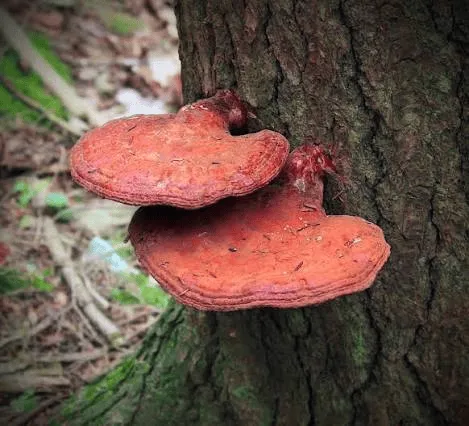
Deep in the forests of North America, a biological marvel known as Ganoderma tsugae, or the reishi hemlock, clings to eastern hemlock trees and other conifers. A naturally lacquered cap surface characterizes laccate mushrooms, like this native fungus.
Its cap has a shiny, lacquer look, which is a characteristic of the laccate Ganoderma species. While the flesh is soft when this fungus is young, it hardens and becomes tough with age. Often confused with its famous Asian relative, Ganoderma lucidum, this Reishi is also a powerhouse of North American pharmacology.
The hemlock reishi has value mainly through the broader reishi mushroom industry, which includes dried mushrooms, extracts, powers, teas, capsules, and other functional-food products. Its commercial worth is tied to its demand for medicinal and wellness products built around its species. Currently, the global reishi mushroom industry is worth around $5 billion, and is forecasted to reach $11.53 billion by 2032.
A fungal immunomodulatory protein from the reishi hemlock, known as FIP-gts, has shown laboratory activity against cancer cells, including effects on telomerase, cell survival, and autophagy-related pathways. FIp–gts has been studied for its potential to influence chemotherapy-resistant cells in preclinical research. Furthermore, in laboratory fermentation studies, the reishi hemlock has been grown in lactose-containing, or dairy-containing, media, which can help increase fungal biomass and polysaccharide production.
Mature reishi hemlock fruiting bodies are typically too tough for ordinary cooking, but the white margin at the growing edge may be used as an edible ingredient when fresh. In practice, this species is used most often for teas and extracts, since hot-water extraction helps pull out water-soluble polysaccharides, while alcohol-based extraction pulls triterpenoids.
Enthusiasts can grow this species on logs or submerged in fermentation tanks, though it is incredibly sensitive to motion. Stirring its growth medium faster than 120 rotations per minute can destroy cells and stop medicine production. Historically, this Reishi served as a physical dressing for skin wounds, and scientists are now testing its ability to break down industrial dyes.

Join The Mushroom Journey
Peak foraging season spans summer and fall, but keep in mind this piece is neither an identification manual nor a medical prescription. Consistently purchase mushrooms from trusted vendors and prepare them with thorough cooking. Never consume wild mushrooms lacking in person verification by a qualified expert. To uncover hundreds of native gourmet, functional, and practical mushroom videos, products, and events, subscribe to the free newsletter at NourishCap.com.
Sources Cited
Chen, Deng-Hai, and William Kuan-Dee Chen. "Determination of Ganoderic acids in Triterpenoid Constituents of Ganoderma tsugae." Journal of Food and Drug Analysis, vol. 11, no. 3, 2003, pp. 195-201. https://doi.org/10.38212/2224-6614.2699
Data Bridge Market Research. Reishi Mushroom Market – Global Market Size, Share and Trends Analysis Report – Industry Overview and Forecast to 2032. Data Bridge Market Research, https://www.databridgemarketresearch.com/reports/global-reishi-mushroom-market.
Kuo, Michael. "Ganoderma tsugae." MushroomExpert.Com, Jan. 2019, http://www.mushroomexpert.com/ganoderma_tsugae.html
Wachtel-Galor, Sissi, et al. "Ganoderma lucidum (Lingzhi or Reishi)." Herbal Medicine: Biomolecular and Clinical Aspects. 2nd ed., CRC Press/Taylor & Francis, 2011. National Center for Biotechnology Information, https://www.ncbi.nlm.nih.gov/books/NBK92757/.
Serody, Joshua, et al. "Submerged Fermentation of Ganoderma tsugae for the Optimized Production of Exopolysaccharides." Finger Lakes Community College, 2024. [Source 178-185 in Workbook].
Wikipedia contributors. "Ganoderma tsugae." Wikipedia, The Free Encyclopedia, https://en.wikipedia.org/wiki/Ganoderma_tsugae
About the Author
Benjamin Ashpole is a certified forager through the Hoosier Mushroom Society, a mushroom educator, and a media producer. Ben writes a widely syndicated column on North American gourmet and functional fungi to inspire mushroom curiosity. As founder of NourishCap.com, he creates educational videos at youtube.com/@NourishCap that demystify everything from forest foraging and home cultivation to the science behind functional and medicinal species. Drawing on years of field experience and ongoing reporting about global fungal science, to support media production, Ben and his team maintain a marketplace of mushroom product vendors and service providers at NourishCap.com so that everyday people can safely benefit from the hidden fungal world around them. Contact Benjamin if you’d like to know more about a specific mushroom, join a foray, request a presentation, or get help with identification at facebook.com/NourishCap. For identification help via Facebook: share pictures of the mushroom’s top, sides, bottom, and habitat along with the name of the closest city and state.


