Birch Bolete: The Black-Turning Mushroom Still Surprising Scientists
Benjamin Ashpole
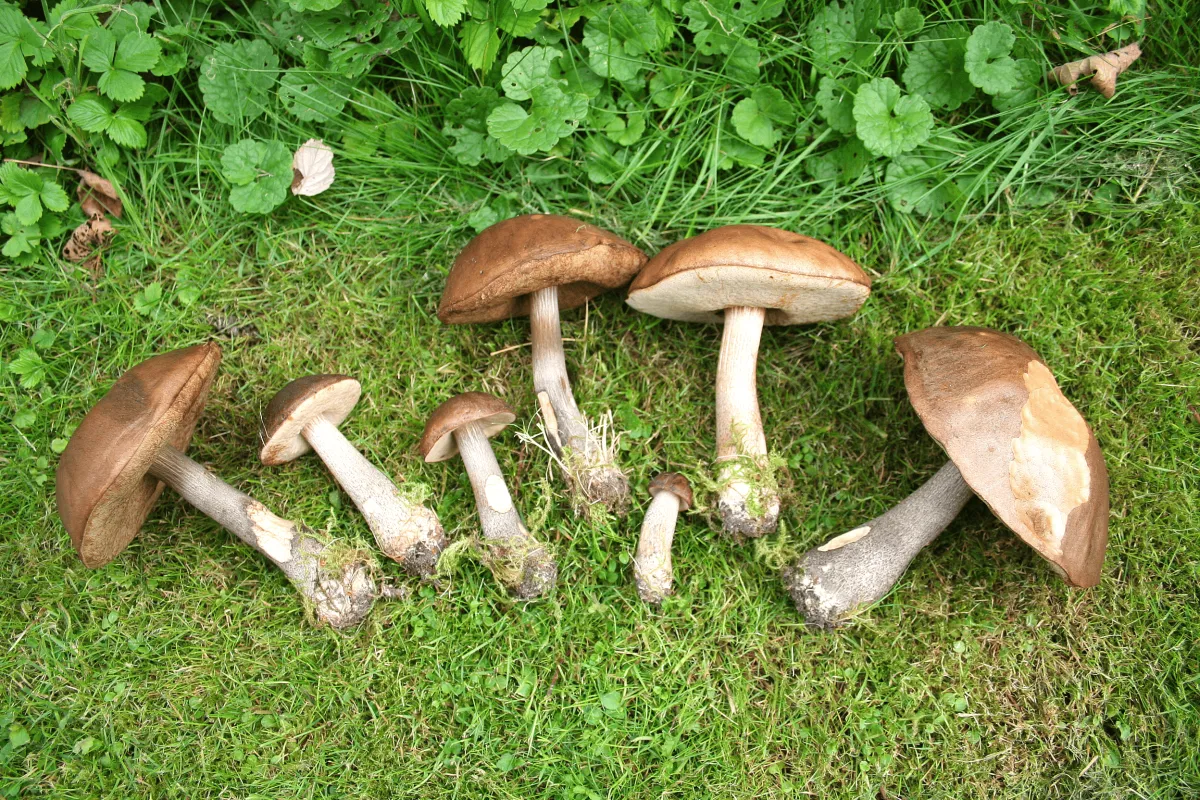
At first glance, the birch bolete (Leccinum scabrum), also known as the brown birch bolete, looks like an ordinary woodland mushroom. Found in association with birch trees across Europe and North America, it has a brown cap that often becomes smoother with age and a pale stem covered with tiny dark projections called scabers (den Bakker & Noordeloos, 2005; Burke Herbarium, n.d.; First Nature, n.d.). Its flesh is usually whitish and changes little when cut, although it may become slightly brownish or pinkish after exposure to air (Burke Herbarium, n.d.; First Nature, n.d.).
Unlike cultivated mushrooms such as oyster or shiitake, the birch bolete forms an ectomycorrhizal association with living birch roots. It is therefore generally collected from the wild rather than grown on wood, straw, or compost-based substrates (Budău et al., 2026; Ostry et al., 2011).
Although long valued as an edible mushroom throughout Northern, Central, and Eastern Europe, L. scabrum has also attracted scientific interest. In a 2024 laboratory study, researchers found that an extract from the mushroom slowed the activity of enzymes that break carbohydrates into sugar. One of these enzymes, called α-glucosidase, helps break carbohydrates into glucose that can then be absorbed by the body. The extract strongly inhibited α-glucosidase while showing much weaker effects on another digestive enzyme, α-amylase. These findings came entirely from laboratory experiments and should not be interpreted as evidence that eating the mushroom prevents or treats diabetes (Ferraro et al., 2024).
The birch bolete is an edible mushroom with a mild taste, though older specimens often become soft or spongy (Burke Herbarium, n.d.). It can be cooked or dried for later use (MykoWeb, n.d.). One feature that can surprise cooks is that its off-white flesh may turn black when handled or after cooking (Gargano et al., 2024). Because gastrointestinal illness has been reported after consumption of some inadequately cooked Leccinum mushrooms, they should be thoroughly cooked before eating (Oregon Discovery, 2020).
Scientists have also studied the species because its fruiting bodies can accumulate certain heavy metals, making it a useful bioindicator of forest soil contamination (Falandysz, 2018).
The birch bolete typically fruits from late summer through autumn in the eastern United States, although the exact fruiting period varies with local climate and rainfall (Ostry et al., 2011). This article is not identification or medical advice. Always purchase mushrooms from reputable sources or have wild specimens verified by an expert before consumption. Join the free newsletter at NourishCap.com for gourmet, functional, and practical mushroom videos, products, and events.

Image Credit for Birch Bolete in Nature:
Jea-Pol GRANDMONT, Leccinum scabrum JPG7, licensed under CC BY-SA 3.0. Original: Wikimedia Commons.
Source:https://commons.wikimedia.org/wiki/File:Leccinum_scabrum_JPG7.jpg
License:https://creativecommons.org/licenses/by-sa/3.0/
Sources Cited
Budău, R., Vicaș, S. I., Bei, M. F., Dejeu, D. A., Dinca, L., & Chira, D. (2026). The genus Leccinum: Global advances in taxonomy, ecology, nutritional value, and environmental significance. Journal of Fungi, 12(1), 70. https://doi.org/10.3390/jof12010070
Burke Herbarium. (n.d.). Leccinum scabrum. https://burkeherbarium.org/imagecollection/taxon.php?Taxon=Leccinum%20scabrum
den Bakker, H. C., & Noordeloos, M. E. (2005). A revision of European species of Leccinum Gray and notes on extralimital species. Persoonia Supplement, 18(4), 511–570. http://noordeloos.allesoverpaddenstoelen.nl/html/leccinum_eng.html
Falandysz, J. (2018). Mineral constituents in Leccinum scabrum from lowland locations in central Europe and their relation to concentration in forest topsoil. Journal of Environmental Science and Health, Part B, 53(8), 546–560. https://doi.org/10.1080/03601234.2018.1462914
Ferraro, V., Spagnoletta, A., Rotondo, N. P., Marsano, R. M., Miniero, D. V., Balenzano, G., De Palma, A., Colletti, A., Gargano, M. L., Lentini, G., & Cavalluzzi, M. M. (2024). Hypoglycemic properties of Leccinum scabrum extracts—An in vitro study on α-glucosidase and α-amylase inhibition and metabolic profile determination. Journal of Fungi, 10(10), 718. https://doi.org/10.3390/jof10100718
First Nature. (n.d.). Leccinum scabrum (Brown birch bolete). https://www.first-nature.com/fungi/leccinum-scabrum.php
Gargano, M. L., Balenzano, G., Venturella, G., Cavalluzzi, M. M., Rotondo, N. P., Lentini, G., Cirlincione, F., Mirabile, G., Zapora, E., Wołkowycki, M., Pecoraro, L., & Ferraro, V. (2024). Nutritional contents and antimicrobial activity of the culinary-medicinal mushroom Leccinum scabrum. Mycology. https://doi.org/10.1080/21501203.2024.2342519
MykoWeb. (n.d.). Leccinum scabrum. https://www.mykoweb.com/CAF/species/Leccinum_scabrum.html
Oregon Discovery. (2020). Birch bolete aka scaber stalk. https://oregondiscovery.com/birch-bolete
Ostry, M. E., Anderson, N. A., & O’Brien, J. G. (2011). Field guide to common macrofungi in eastern forests and their ecosystem functions (General Technical Report NRS-79). U.S. Department of Agriculture, Forest Service, Northern Research Station. https://research.fs.usda.gov/download/treesearch/38089.pdf
About the Author
Benjamin Ashpole is a certified forager through the Hoosier Mushroom Society, a mushroom educator, and a media producer. Ben writes a widely syndicated column on North American gourmet and functional fungi to inspire mushroom curiosity. As founder of NourishCap.com, he creates educational videos at youtube.com/@NourishCap that demystify everything from forest foraging and home cultivation to the science behind functional and medicinal species. Drawing on years of field experience and ongoing reporting about global fungal science, to support media production, Ben and his team maintain a marketplace of mushroom product vendors and service providers at NourishCap.com so that everyday people can safely benefit from the hidden fungal world around them. Contact Benjamin if you’d like to know more about a specific mushroom, join a foray, request a presentation, or get help with identification at facebook.com/NourishCap. For identification help via Facebook: share pictures of the mushroom’s top, sides, bottom, and habitat along with the name of the closest city and state.


