
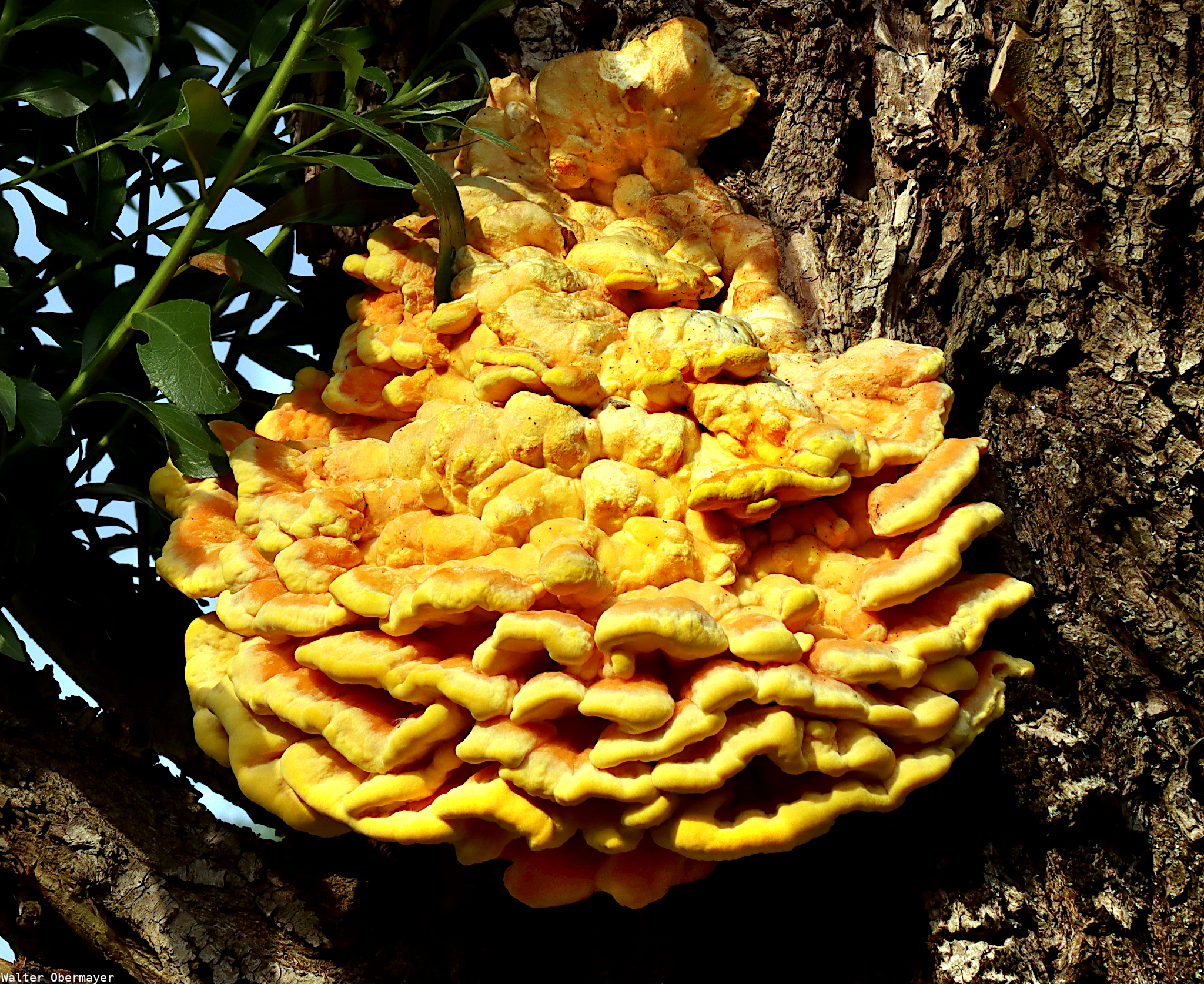
Local Mushroom of the Week, Chicken Of The Woods, A Forest Parasite Saving Lives
Benjamin Ashpole
Residents of North America might soon observe vivid yellow shelves growing from local oak trunks. This fungus, Chicken Of The Woods, is a natural contradiction. Sometimes, it causes the wood to turn reddish-brown and powdery, a process called brown heart rot. While this eventually kills host trees, it simultaneously carves out vital nesting cavities for forest animals. Widely found east of the Rocky Mountains, French mycologist Pierre Bulliard first named this species in 1789. Today, this tree pathogen is the focus of a massive scientific and economic shift.
Laetiporus sulphureus is valued not only as an edible fungus in Europe and Asia, but also for its rare pigment chemistry. As the global market for natural dyes and pigments was estimated to be worth around $2.7 billion back in 2026 and expected to reach $4.6 billion by 2034, especially the orange polyene pigments known as laetiporic acids, pigments from species like Laetiporus sulphureus are attracting attention as sustainable alternatives to synthetic dyes.
While this fungus kills trees, it also has various functional medicinal compounds. Scientists have proved that its specialized sugar chains, called F2-sulfated polysaccharides, can stop the spread of aggressive breast cancer cells without hurting healthy tissue. Furthermore, its potent anti-inflammatory compounds, known as Sulphurenoids, are more effective than some common pharmaceutical drugs. It also helps manage blood sugar by helping regenerate pancreatic cells and reduces tissue damage from ulcerative colitis by 60 percent.
Gourmet chefs prize the succulent, fibrous outer edges that mimic poultry when sautéed or grilled. This meaty profile makes it a popular plant-based substitute that is high in protein and minerals. However, a structural component of cell walls that is hard for humans to digest, called chitin, causes severe stomach distress if the mushroom is eaten raw.
You can grow this giant at home on hardwood logs or indoor sawdust. Fruiting is initiated by a sudden reduction in gas levels, or carbon dioxide stepdown. Practically, it produces a water-insoluble structural fiber referred to as alpha-1,3-Glucan. This material is used to create moisture-resistant biodegradable films that might replace single-use plastics.
Peak foraging season is May to October, but this is not an identification guide or medical advice. Buy from reputable sources and cook well. Never eat wild foods without human-expert identification. Join the newsletter at NourishCap.com for more videos.

Join The Mushroom Journey
Peak foraging season spans summer and fall, but keep in mind this piece is neither an identification manual nor a medical prescription. Consistently purchase mushrooms from trusted vendors and prepare them with thorough cooking. Never consume wild mushrooms lacking in person verification by a qualified expert. To uncover hundreds of native gourmet, functional, and practical mushroom videos, products, and events, subscribe to the free newsletter at NourishCap.com.
Sources Cited
Adamska, Izabela. "The possibility of using sulphur shelf fungus (Laetiporus sulphureus) in the food industry and in medicine—A review." Foods, vol. 12, no. 7, 2023, https://doi.org/10.3390/foods12071539
Ali, Sharafat, et al. "Laetiporus sulphureus polysaccharides mitigate colitis by reshaping the gut microbiota and regulating immune responses." Frontiers in Pharmacology, vol. 17, 2026, https://doi.org/10.3389/fphar.2026.1705032
"Comprehensive Biochemical, Physiological, and Industrial Profile of Laetiporus sulphureus." NourishCap Research Archive, 2026.
"EP4344535A1 - Methods and substrates for inducing and growing fruiting bodies of the fungus laetiporus sulphureus as a vegan meat substitute." European Patent Office, 2024, https://patents.google.com/patent/EP4344535A1/en
Karunarathna, Samantha C., et al. "Basidiomycete pigments as sustainable food colorants and stabilizers: from fungal biology to industrial potential." Frontiers in Microbiology, vol. 16, 2025, https://doi.org/10.3389/fmicb.2025.1725536
Kowalczyk, Dariusz, et al. "Evaluation of Film-Forming Properties of α-1,3-Glucan Obtained from 'Chicken of the Woods' Mushroom (Laetiporus sulphureus)." Molecules, vol. 30, no. 7, 2025, https://doi.org/10.3390/molecules30071619
"Laetiporus sulphureus." Ultimate Mushroom, https://ultimate-mushroom.com/edible/38-laetiporus-sulphureus.html
"Laetiporus sulphureus." Wikipedia, 2025, https://en.wikipedia.org/wiki/Laetiporus_sulphureus
Raksha Sharma. "Natural Pigment Market" Data Intelo, May 2026, https://dataintelo.com/report/natural-pigment-market
Tangedal, Mike. "KF-COW: Cooking with Chicken of the Woods." Minnesota Mycological Society, 2023, https://minnesotamycologicalsociety.org/2023/07/01/kf-cow/
About the Author
Benjamin Ashpole is a certified forager through the Hoosier Mushroom Society, a mushroom educator, and a media producer. Ben writes a widely syndicated column on North American gourmet and functional fungi to inspire mushroom curiosity. As founder of NourishCap.com, he creates educational videos at youtube.com/@NourishCap that demystify everything from forest foraging and home cultivation to the science behind functional and medicinal species. Drawing on years of field experience and ongoing reporting about global fungal science, to support media production, Ben and his team maintain a marketplace of mushroom product vendors and service providers at NourishCap.com so that everyday people can safely benefit from the hidden fungal world around them. Contact Benjamin if you’d like to know more about a specific mushroom, join a foray, request a presentation, or get help with identification at facebook.com/NourishCap. For identification help via Facebook: share pictures of the mushroom’s top, sides, bottom, and habitat along with the name of the closest city and state.


